As an Amazon Associate, I earn from qualifying purchases. This post may contain affiliate links, meaning I get a commission if you decide to make a purchase through my links, at no cost to you.
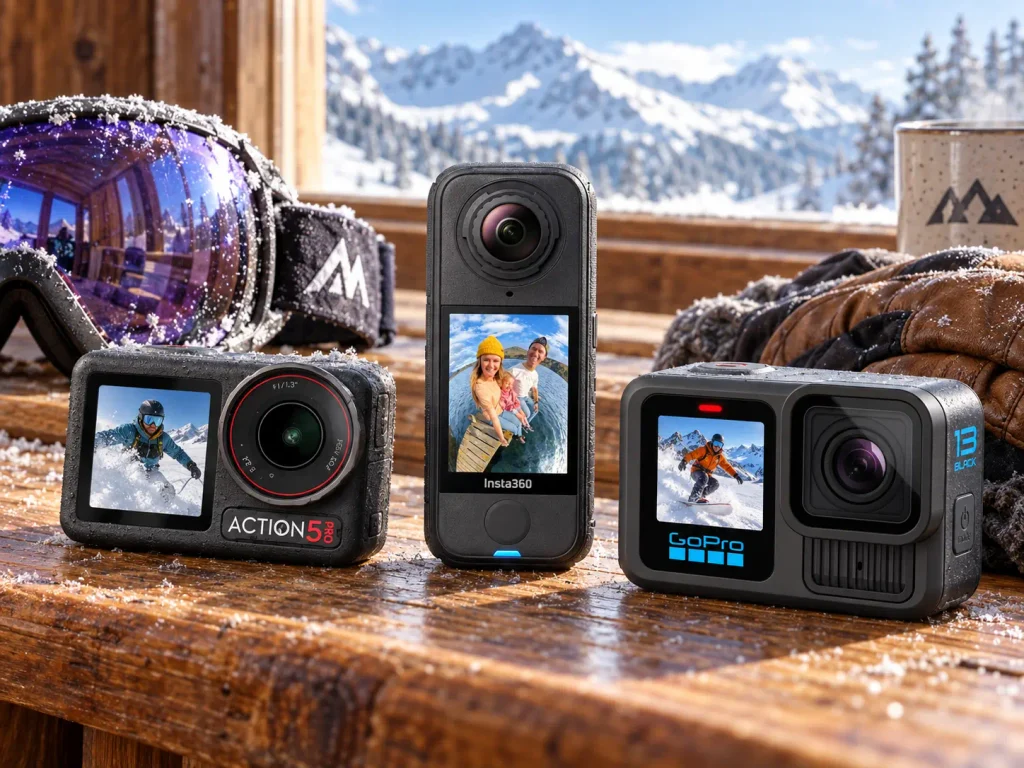
Finding the best action camera for skiing comes down to surviving two things that destroy ordinary electronics: sub-zero windchill and blinding alpine glare.
Pulling a bare smartphone out on a swinging chairlift rarely ends well. Either your fingers go numb before the camera app opens, or the battery drops forty percent before you reach the summit.
Strapping a heavy, poorly balanced camera onto your headgear creates its own hazards. Tall plastic mounts can catch on low tree branches or compromise helmet balance during a crash, a concern echoed in federal winter sports helmet safety guidelines.
You do not need to pay top dollar for late-2025 camera refreshes that brought minor sensor tweaks and early firmware bugs. Three battle-tested flagships offer far better cold-weather stability and value for the 2026 season.
The DJI Osmo Action 5 Pro leads the pack for freezing battery stamina. The Insta360 X4 handles 360-degree solo filming without aiming, while the GoPro Hero 13 Black remains the sharpest traditional point-of-view camera on snow.
Comparing the Best Action Camera for Skiing by Riding Style
| Product & Key Spec | Where It Shines (and Its Trade-off) | Where to Buy |
|---|---|---|
| DJI Osmo Action 5 Pro — 1/1.3" Sensor, 1950mAh (-4°F) | Longest cold-weather battery runtime, 47GB built-in memory, and rapid magnetic mount, though resolution caps at 4K. | View on Amazon |
| Insta360 X4 — 8K30 360° Capture, 2290mAh (-4°F) | Drone-like third-person views with zero aiming required, but protruding fisheye lenses need careful protection. | View on Amazon |
| GoPro Hero 13 Black — 5.3K60 Video, 1900mAh (14°F) | Sharpest traditional POV footage and automatic 177° wide lens detection, yet shows more grain at dusk. | View on Amazon |
DJI Osmo Action 5 Pro — The Sub-Zero Battery and Low-Light Champion
Most action cameras chime a low-battery warning twenty minutes after you leave the gondola. DJI tackles cold weather action camera battery life directly by fitting the Action 5 Pro with a 1950mAh extreme battery rated down to -4°F (-20°C).
By DJI’s official winter specifications, that single battery delivers up to 3.6 hours of continuous recording in freezing air. That is enough juice to film from first chair to lunch without unzipping your parka.
The 145-gram chassis also includes 47GB of internal memory, saving your run if you leave your memory card on the hotel nightstand. Its fiberglass-reinforced frame meets strict IEC IP68 waterproof testing standards down to 20 meters without an external housing.

Winter light turns notoriously flat by mid-afternoon when clouds roll over the ridge. DJI’s larger 1/1.3-inch CMOS sensor packs 13.5 stops of dynamic range, preserving shadow detail in dark pine trees without blowing out bright snowbanks.
Fumbling with frozen thumb screws in a windy parking lot is miserable. DJI uses a spring-loaded magnetic clamp that snaps cleanly onto helmet or chest buckles while you keep your thick mittens on.
The main limitation on the spec sheet is resolution, which maxes out at 4K/120fps rather than GoPro’s 5.3K. Unless you plan to crop heavily on a desktop monitor, that trade-off barely registers on social media or a 4K living room television.
For skiers who want a tough, glove-friendly action camera that turns on instantly in January weather and runs all morning, the Action 5 Pro is the smartest pick.
Check current price of DJI Osmo Action 5 Pro on Amazon
Insta360 X4 — The Third-Person 360 Studio for Solo Riders
Traditional cameras force you to guess where the lens is pointing. If your helmet mount tilts ten degrees too low, you come home with four hours of footage staring at your own ski boots.
The Insta360 X4 skips aiming altogether by recording a full 8K30fps 360-degree sphere around your body. It captures the trail ahead, the rooster tail of snow behind your heels, and your own reaction in one pass.
Thread the camera onto an extended carbon pole, and its dual-lens stitching software erases the stick from the video. The resulting footage looks like a follow-cam drone hovering three feet off your shoulder.
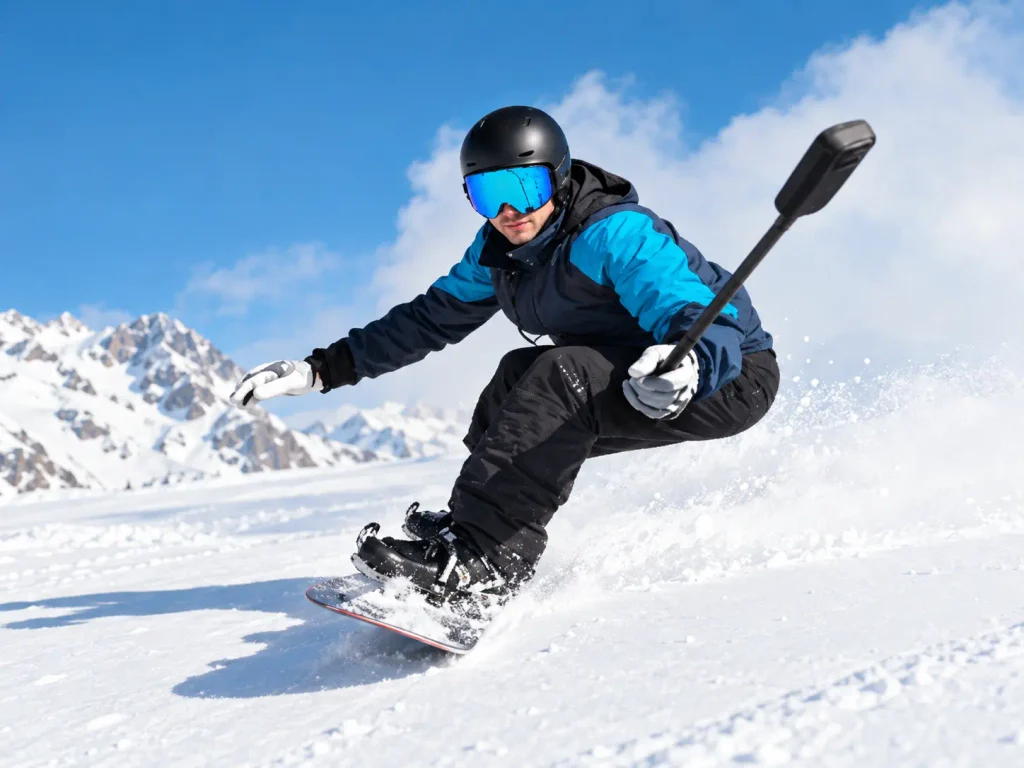
Once you are back at the lodge with a warm drink, you open the smartphone app to pick your camera angles. Built-in FlowState stabilization keeps the horizon dead level even if your arm swings wildly through the turns.
Because poking a 2.5-inch touchscreen with stiff snowboard gloves rarely works, Insta360 added AI gesture control to the X4. Raising an open palm toward the lens triggers recording with a bright LED flash and a loud beep.
Its 2290mAh battery is rated down to -4°F (-20°C) and runs for roughly 135 minutes in 5.7K mode, though shooting full 8K drains the cell noticeably faster.
The physical catch is durability: both curved fisheye lenses bulge out from the 203-gram body and will scratch on ice without the included removable lens guards. Still, solo snowboarders and park riders chasing third-person perspectives cannot get these angles with a flat camera.
Check current price of Insta360 X4 on Amazon
GoPro Hero 13 Black — The Purist POV Camera for Bluebird Days
Plenty of fast downhill skiers hate spending their evenings scrubbing through 360-degree timelines on a phone screen. They just want crisp, wide-angle clips ready to share the second they pop out the memory card.
The GoPro Hero 13 Black is built for that straightforward workflow, shooting 5.3K60 video resolution with 91 percent more pixels than standard 4K. Its nearly square 8:7 image sensor lets you pull vertical TikTok reels and widescreen YouTube videos from the exact same run.
What makes the Hero 13 especially compelling on steep terrain is its automatic pairing with the snap-on Ultra Wide Lens Mod. Clicking that glass onto the front expands the field of view to a massive 177 degrees at 4K60, making narrow tree chutes look properly terrifying.

GoPro ships the camera with a redesigned 1900mAh Enduro battery engineered for cold operation down to 14°F (-10°C). While that rating does not reach DJI’s sub-zero floor, it comfortably handles typical resort afternoons.
GoPro also restored built-in GPS on the Hero 13 so you can overlay speed gauges and elevation graphs inside the Quik app. Better still, a new magnetic latch base finally replaces the old plastic mounting fingers.
Where the Hero 13 shows its age is its smaller 1/1.9-inch sensor, which introduces muddy digital grain during night skiing or shadowy late-day runs.
If you ride primarily under bright skies and demand the sharpest helmet mount POV camera optics on the market, GoPro remains the downhill benchmark.
Check current price of GoPro Hero 13 Black on Amazon
Taming Snow Glare, Cold Memory Cards, and Resort Pole Rules
Fresh snow reflects up to eighty percent of ambient UV light, forcing action cameras onto super-fast shutter speeds that make choppy snow look jittery. Snapping a neutral density ND16 optical filter over your lens cuts that harsh glare and restores smooth, natural motion blur.
Cold temperatures also slow down cheap flash memory, causing high-bitrate 4K and 8K recordings to stutter or corrupt mid-run. Pair your camera with a temperature-proof SanDisk Extreme PRO UHS-I V30 microSD card rated to survive freezing conditions.
Before packing your boot bag, check our guide on [keeping winter electronics alive on the mountain](Internal Link: Cold Weather Battery Care and Winter Electronics Guide) to set up a reliable pocket-warming routine for your spare cells.
Before you buy an Insta360 X4, check your home mountain’s trail map rules. Several major North American resorts now prohibit handheld extension poles on chairlifts and crowded runs, which neutralizes the main reason to carry a 360 camera.
Similarly, if you know that huge video files will just sit untouched on your laptop until next Christmas, skip dedicated action cameras altogether. Keep your smartphone tucked inside a warm chest pocket and take a few summit photos instead.
Answering the Toughest Winter Action Camera Questions
Why does a chest mount work better for skiers than snowboarders?
A chest mount works better for downhill skiers because their torso faces straight down the fall line, framing both skis and poles symmetrically, whereas a snowboarder’s sideways stance points a chest-mounted camera toward the trees along the side of the trail.
For skiers, strapping the camera at sternum height creates a faster, steeper sense of terrain than a high helmet mount ever can. Snowboarders get much better coverage from a low-profile helmet chin mount or a short hand grip that swings cleanly through heel-side and toe-side turns.
How do you stop an action camera lens from fogging up in the snow?
Stopping an action camera lens from fogging up in the snow requires sealing the battery door inside cold, dry air rather than a humid ski lodge and avoiding unnecessary external plastic dive cases that trap heat against the freezing outer glass.
All three cameras in this guide are factory-waterproof from 10 to 20 meters without an extra housing. When you carry a warm camera out of the cafeteria into ten-degree air, give the chassis five minutes to cool down before hitting record so internal processor heat does not condense behind the lens cover.
Are 8K and 5.3K video modes worth the massive file sizes on a ski trip?
Shooting in 8K on a 360 camera is worth the storage cost because reframing a standard flat video cuts the resolution down to roughly 1080p, whereas shooting 5.3K on a traditional POV camera is only necessary if you plan to crop in during editing.
A single hour of 8K or 5.3K footage can easily devour 45 to 60 gigabytes of card space and choke hotel Wi-Fi backups. For standard point-of-view cameras like DJI and GoPro, recording in 4K at 60 frames per second delivers crisp slow-motion playback while keeping file transfers manageable on your phone.
Making the Final Call Before You Hit the Chairlift
For the vast majority of skiers heading to the mountains in 2026, the DJI Osmo Action 5 Pro is the most dependable camera you can buy. Its sub-zero battery endurance, 47GB of backup memory, and mitten-friendly magnetic latch take the frustration out of filming in freezing weather.
Solo riders and snowboarders who want floating third-person clips without aiming should grab the Insta360 X4. Downhill purists who ride mostly in bright daylight and want 5.3K sharpness straight off the card belong with the GoPro Hero 13 Black.
Check current price of DJI Osmo Action 5 Pro on Amazon
Want more recommendations? Head back to our homepage to see all our everyday picks.