As an Amazon Associate, I earn from qualifying purchases. This post may contain affiliate links, meaning I get a commission if you decide to make a purchase through my links, at no cost to you.
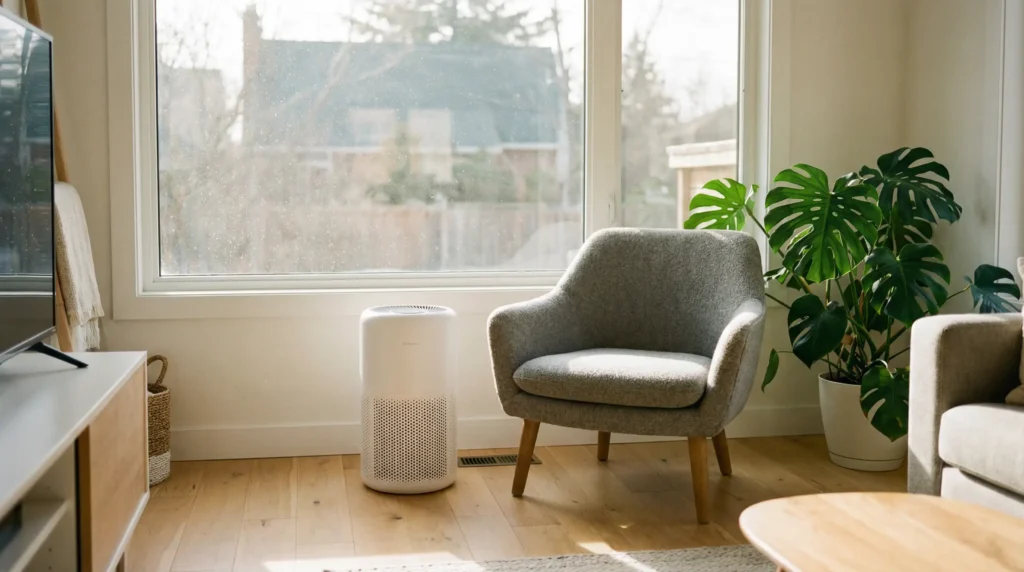
Finding the best air purifiers for allergies shouldn’t feel like a high-stakes guessing game right when tree pollen turns your car neon yellow.
Every late February, the exact same story plays out.
You step outside in the morning, breathe in a cloud of oak or cedar dust, and by lunchtime your eyes are burning, your sinuses ache, and you’re tearing through medicine cabinets for antihistamines that leave you feeling like a zombie.
According to data from the Asthma and Allergy Foundation of America (AAFA), seasonal allergy spikes are arriving earlier and packing a heavier particulate punch each year.
Panic-buying a random plastic tower on Amazon usually ends with a loud, underpowered fan taking up floor space while doing next to nothing for your actual breathing.
To save you the headache, I sifted through the market to find models that actually deliver: genuine True HEPA filtration, sensible running costs, and livable noise levels.
Here is what made the roster:
- LEVOIT Core 300-P: The quiet bedside specialist. It skips flashy displays in favor of an upgraded cylindrical H13 True HEPA filter and a motor quiet enough (24dB) to run inches from your pillow.
- Coway Airmega AP-1512HH: The high-volume living room anchor. With wide perimeter suction and an intelligent sensor that cuts power when the air is clean, it is built to handle heavy pollen traffic.
- WINIX 5510: The dual-threat odor and dander neutralizer. Instead of using a disposable foam sheet dusted with carbon spray, it features a heavy honeycomb grid packed with actual granular carbon pellets.
Quick Comparison
| Air Purifier | What It Does Best | Live Pricing & Deals |
|---|---|---|
| LEVOIT Core 300-P | 24dB quiet sleep profile with an upgraded 360° cylindrical H13 HEPA. Best for bedrooms up to 219 sq ft. | View on Amazon |
| Coway Airmega AP-1512HH | Perimeter suction with an auto-regulating Eco Mode. Best for living rooms and active pet homes up to 361 sq ft. | View on Amazon |
| WINIX 5510 | Granular carbon pellet honeycomb + Wi-Fi smart controls. Best for open kitchens and stubborn odors up to 500+ sq ft. | View on Amazon |
1. LEVOIT Core 300-P: The Best Bedroom Air Purifier for Allergies
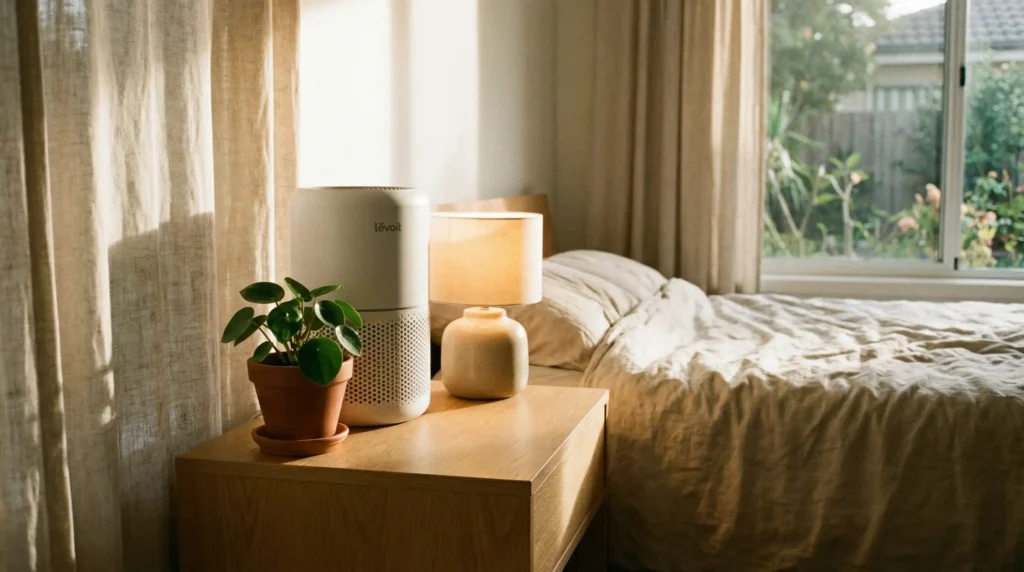
If you only install one air purifier in your entire home this spring, put it where you sleep.
You spend roughly eight hours every night lying horizontal in your bedroom.
Inhaling microscopic oak, birch, or cedar pollen trapped in your bedding all night is precisely why you wake up feeling like you have a head cold.
The LEVOIT Core 300-P is the updated retail iteration of Levoit’s classic Core platform.
Visually, it keeps that familiar clean cylinder shape.
Under the hood, Levoit tightened the internal motor tolerances and revised the airflow ducting to eliminate high-pitched electrical hums.
The outer shell is finished in a smooth, matte white polymer that rejects fingerprints.
Pick it up, and it feels reassuringly dense. There is no creaky plastic flex when you grab it, and the low center of gravity keeps it firmly planted on a nightstand.
The engineering relies on Levoit’s VortexAir intake.
It draws air from every direction around the lower perforated base, pushes it through an H13-grade True HEPA filter, and exhausts clean air straight out the spiral top vent.
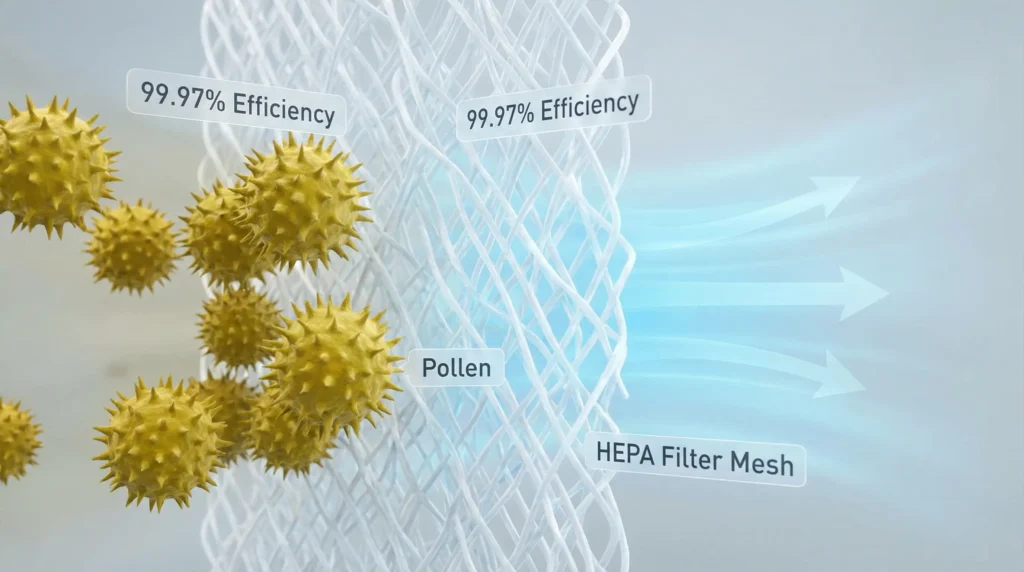
According to guidelines from the U.S. Environmental Protection Agency (EPA), certified HEPA media must capture at least 99.97% of airborne particles down to 0.3 microns—which makes short work of outdoor pollen spores.
On Sleep Mode, the fan drops down to 24 decibels.
That is library-quiet. It registers as a faint, soothing ambient breeze rather than an electric appliance, making it easy to sleep through without disturbance.
The trade-off here comes down to controls. The Core 300-P is a completely manual machine.
There is no laser air quality sensor on this unit, meaning it will not speed up automatically if pollen levels suddenly spike outdoors.
If you want more airflow in the middle of a bad afternoon, you have to walk over and tap the capacitive touch controls yourself.
The top console does include a display-off switch, which is a lifesaver if you hate stray LEDs glowing in your eyes at midnight.
For small-to-medium bedrooms where your main goal is clean, sneeze-free sleep on a reasonable budget, it remains tough to beat.
👉 Check Current Price & Deals for LEVOIT Core 300-P on Amazon
2. Coway Airmega AP-1512HH: The Living Room Air-Scrubbing Tank
Living rooms and open-concept spaces present an entirely different problem than closed bedrooms.
Every time someone opens the front door or a dog bounds inside from the yard, a fresh plume of pollen, road dust, and pet dander settles into your rugs.
A compact bedside cylinder simply can’t pull enough air volume to keep up with that space.
The Coway Airmega AP-1512HH has earned a dedicated following for one simple reason: its airflow architecture moves serious cubic feet of air.
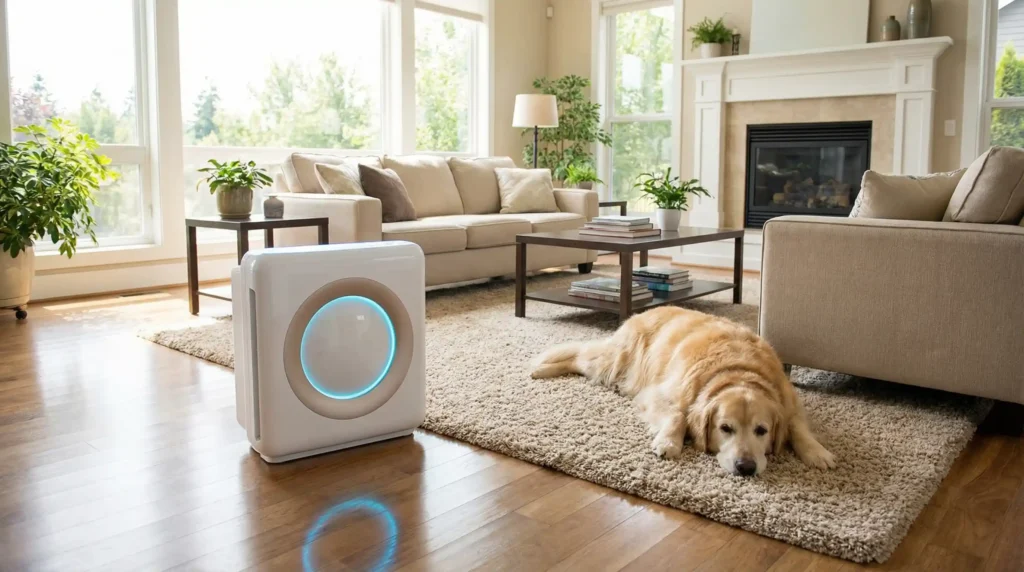
While the square body and center circular vent look a lot like an oversized vintage iPod, that housing hides a remarkably capable motor.
Air gets sucked in forcefully through the front and side perimeter channels, pulled through a multi-stage filtration stack, and launched out through the top exhaust.
The brains of the unit rely on a built-in particle sensor wired to an LED indicator ring.
The light shifts from Blue (clean) to Purple (moderate) to bright Red (polluted).
Its most practical trick is “Eco Mode.”
If the purifier detects clean air for 30 consecutive minutes, the fan shuts off entirely to save electricity.
The moment a gust of outdoor pollen drifts across the room, the sensor wakes the motor back up and ramps up fan speed on its own.
That high-velocity airflow does make its presence known.
Speeds 1 and 2 are easy to talk over, but Speed 3 pushes serious air and sounds like a kitchen exhaust hood running on high. You will definitely know when this machine is working through a bad air spike.
The front plastic panel pops off smoothly with two upper clips, giving you quick access to the mesh pre-filter.
You will want to take a handheld vacuum to that screen every two to three weeks to pull off pet hair and lint.
Keeping that outer screen clear ensures the internal True HEPA filter can focus on capturing fine pollen grains rather than choking on pet fluff.
👉 Check Current Price & Deals for Coway Airmega AP-1512HH on Amazon
3. WINIX 5510: The Smart Heavyweight for Kitchens and Pet Odors
Spring allergies often don’t happen in a vacuum.
If your home also contends with greasy cooking smells, volatile organic compounds (VOCs) from cleaning supplies, or wet dog odors, a standard micro-fiber filter can leave your living space smelling musty.
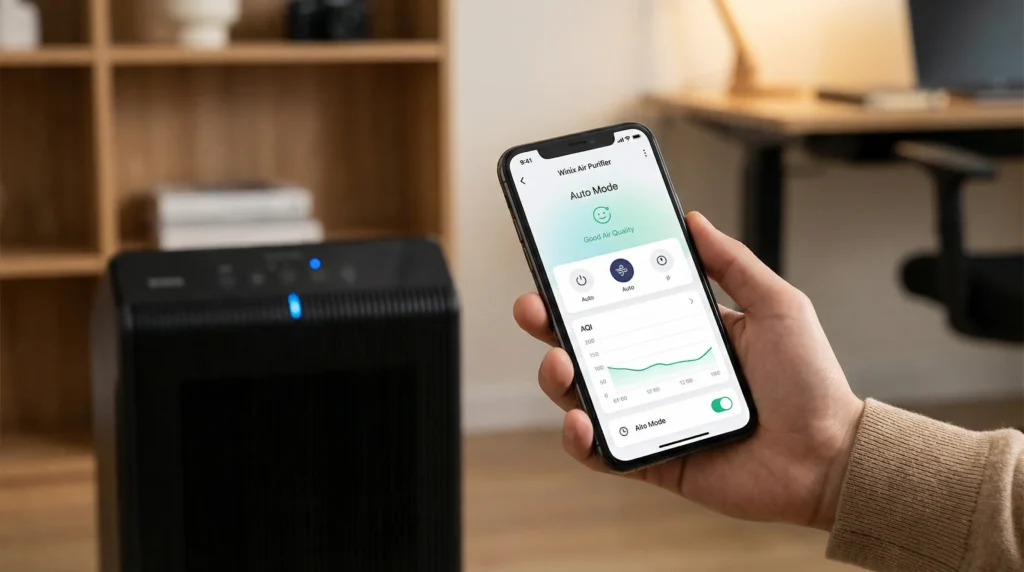
The WINIX 5510 Air Purifier takes a broader approach to indoor air quality.
The unit has a taller, broader stance with a dark charcoal finish and a wide front intake grate.
Its standout design feature is the carbon stage.
Where most budget machines rely on a cheap, paper-thin sheet lightly sprayed with carbon dust, Winix builds its Advanced Odor Control (AOC) filter with a rigid honeycomb frame loaded with genuine, granulated carbon pellets.
Those loose carbon pellets provide physical surface area to chemically bond with kitchen vapors and airborne odors that fly straight through ordinary filters.
Backing up the True HEPA media is Winix’s PlasmaWave technology, which generates an electrical field to help break down pollutants at a molecular level.
Because it connects to Wi-Fi via the Winix Smart App, you can check your room’s air index from your desk at work and trigger a high-speed cleaning cycle an hour before you head home.
A couple of functional quirks are worth noting.
The front LED air quality bar is quite bright. If you place the unit across from a bed, you will definitely want to engage Sleep Mode to shut off the light bar so it doesn’t illuminate your ceiling.
Also, while Winix notes that PlasmaWave complies with strict safety standards for negligible ozone output, some individuals with severe chemical sensitivities prefer purely mechanical filtration.
Winix smartly included a physical hardware button on the console, allowing you to turn PlasmaWave off with a single click and run pure HEPA airflow.
👉 Check Current Price & Deals for WINIX 5510 Air Purifier on Amazon
The Workflow Secret: How to Keep Your HEPA Filter Breathing
Even the best air purifiers will struggle within two or three months if you let the intake vents get choked with everyday household lint.
Treating an air purifier like an appliance you never touch usually leads to strained motors, reduced airflow, and returning sinus headaches.
1. Give the intake 12 inches of clearance
Purifiers rely on negative pressure to pull dirty air into the cabinet.
Shoving a unit tight against drywall or wedging it behind a sofa cuts off intake volume and halves the air changes per hour.
Give the intake vents room to breathe.
2. Vacuum the pre-filter twice a month
Pop open the front panel (on the Coway or Winix) or slide the barrel filter out of the Levoit.
Run a handheld vacuum brush over the outer gray mesh to pull away pet hair, human hair, and heavy dust before it ever reaches the inner core.
3. Keep water away from the True HEPA media
The outermost plastic screens on select machines are washable, but dense, pleated paper HEPA filters are strictly dry-use.
Washing an H13 paper core breaks down its microscopic electrostatic structure, permanently ruining its ability to trap 0.3-micron pollen spores.
Choosing the Best Air Purifiers for Allergies for Your Layout
Instead of looking at raw room coverage numbers alone, think about how you move through your home and what specific problems keep your sinuses inflamed:
If you just want to sleep without waking up congested:
Your priority is simple: zero noise, no glowing light displays in your face, and a machine small enough to sit on a nightstand without rattling the wood.
You don’t need automated laser sensors or Wi-Fi apps for a 150-square-foot bedroom. You just need continuous, quiet filtration so you can wake up breathing through your nose.
👉 Your best match: The LEVOIT Core 300-P
If your front door opens constantly and pets track dust inside:
Your living room is high-traffic. Outdoor pollen blows in every time someone grabs the mail, and pets bring grass allergens inside on their coats.
You don’t have time to manually adjust fan speeds all day. You need a responsive air sensor that kicks on automatically and a washable pre-filter that stops dog hair from ruining your expensive HEPA core.
👉 Your best match: The Coway Airmega AP-1512HH
If your kitchen connects to your living space and smells linger:
Your floor plan is open, meaning seared food, cooking oils, and pet odors hang in the air right alongside outdoor tree allergens.
You want physical carbon pellets to trap odors at the molecular level, plus an app to set daily automated clean cycles before you get home from your commute.
👉 Your best match: The WINIX 5510
A quick layout reality check:
If you have a wide-open floor plan over 2,000 square feet, don’t rely on one single machine in a corner to fix the entire house.
You will get significantly better airflow turnover by placing two medium-sized purifiers in central cross-breeze zones than by overworking a single unit.
Straight Answers for Pollen Season
Do True HEPA air purifiers actually capture tree and grass pollen?
Yes. Outdoor pollen grains from trees, weeds, and grasses generally measure between 10 and 100 microns across.
Certified True HEPA filtration media is tested to trap microscopic particles down to 0.3 microns with at least 99.97% efficiency.
Because pollen particles are physically much larger than the microscopic pores of a HEPA weave, they are captured almost instantly on the very first pass through the machine.
Should I leave an air purifier for allergies running 24/7 during spring?
Yes. Running an air purifier for only an hour or two here and there won’t give you steady relief.
Every time an exterior door opens or your HVAC system turns on, fresh airborne allergens enter the living space.
Leaving your purifier running continuously on a low fan speed—or letting an automatic Eco-mode manage the fan—ensures a constant cycle of clean air while keeping power usage negligible.
When does a HEPA filter realistically need to be replaced?
Manufacturer guidelines typically suggest swapping filters every 6 to 12 months, but regional pollen blooms change the timeline.
In areas hit with aggressive tree pollen seasons or in homes with shedding animals, primary filters can hit capacity closer to the six-month mark.
If you notice a visible reduction in exhaust airflow or detect a faint, stale smell near the top grill, the internal filter media is saturated and needs a fresh replacement.
My Personal Bias: What I Would Buy with My Own Money
If a severe pollen bloom hit tomorrow and I had to spend my own cash on just one unit to keep my sanity intact, my money goes straight to the Coway Airmega AP-1512HH.
The updated Levoit Core 300-P is a fantastic little bedside unit, and the Winix 5510 handles kitchen odors noticeably better thanks to its granular carbon honeycomb.
However, in real daily life, I simply don’t want to babysit fan controls.
The Coway’s Eco Mode hits the sweet spot: it sits quietly beside living room furniture, shuts down when the air is clean, and automatically ramps up the instant someone opens the front door and lets springtime air inside.
When you’re trying to find the best air purifiers for allergies without turning home maintenance into a part-time job, that kind of reliable automation makes all the difference.
Want more recommendations? Head back to our homepage to see all our 2026 everyday picks.