As an Amazon Associate, I earn from qualifying purchases. This post may contain affiliate links, meaning I get a commission if you decide to make a purchase through my links, at no cost to you.
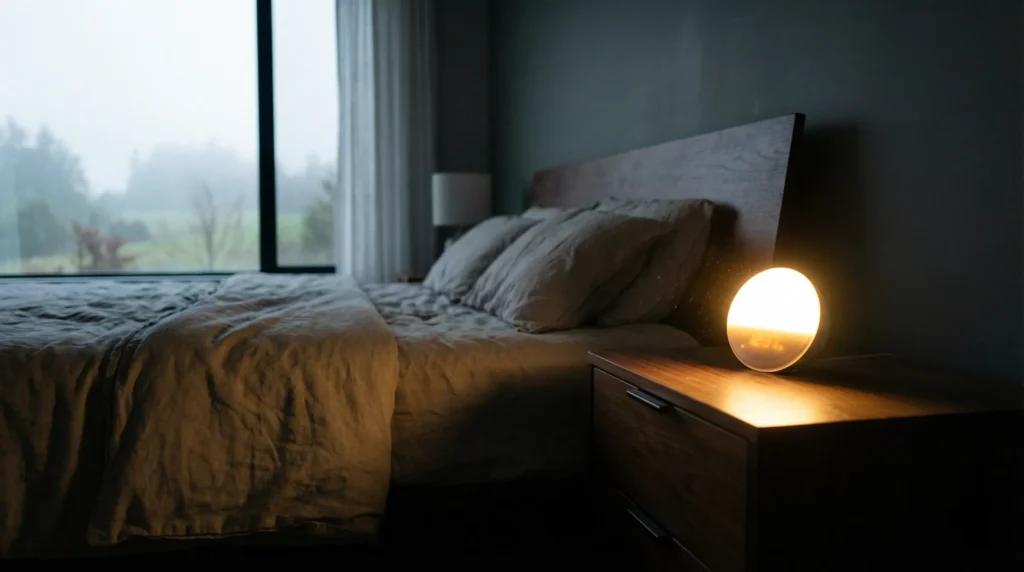
The “spring forward” time change is easily the most brutal weekend of the year for our sleep schedules.
Losing that precious hour of rest messes with your entire morning routine.
Finding a reliable sunrise alarm clock for daylight saving transition is the absolute best way to survive the grogginess.
Waking up in pitch darkness is miserable.
Your body clock screams that it’s still the middle of the night.
Relying on a blaring smartphone alarm usually just causes a morning panic attack.
You end up needing an aggressive amount of espresso just to function.
Wake-up lights change the game by mimicking a natural dawn.
They gradually fill your room with brightness to trick your brain into halting melatonin production.
To help you figure out which one actually fits your nightstand, let’s look at the two heavyweights dominating the space right now.
A Quick Glance at the Contenders
| Product Model | The Vibe & Core Tech | Latest Deals |
|---|---|---|
| Hatch Restore 3 | Soft linen fabric. App-controlled sleep routines. | View on Amazon |
| Philips SmartSleep HF3520/60 | Hard plastic build. Clinically backed 300 Lux light. | View on Amazon |
1.The Hatch Restore 3: The Nightstand Art Piece
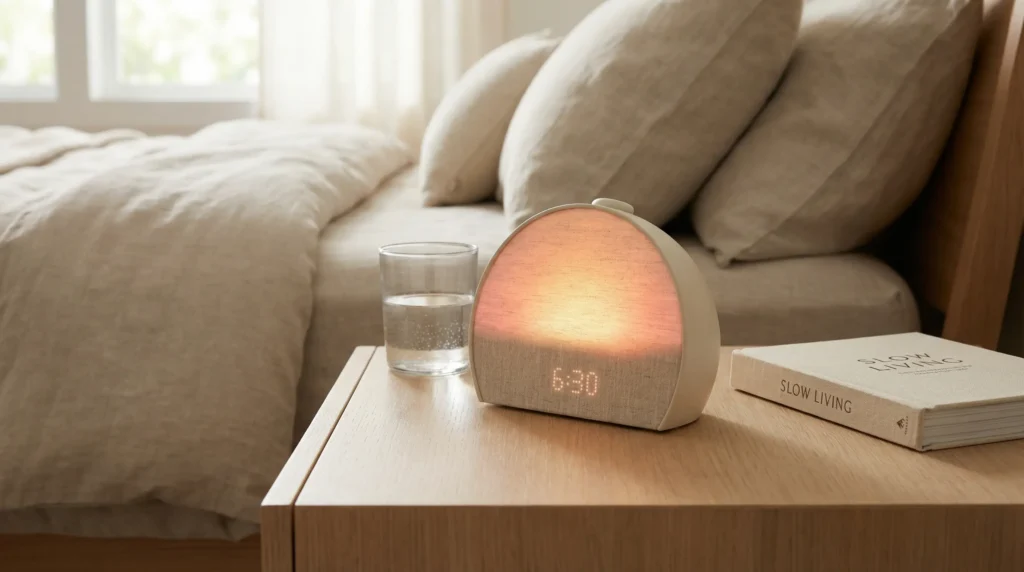
If you care deeply about interior design, look at the Hatch Restore 3.
It completely ignores the traditional digital clock aesthetic.
Instead, it is wrapped in a tactile, high-quality linen fabric.
It looks much more like a premium smart speaker sitting on your nightstand.
But it isn’t just a clock. It is a complete sleep ecosystem.
You use the companion smartphone app to build a custom wind-down routine.
Imagine it casting a dim, campfire-red reading light at 10 PM.
Then it fades into soothing rain sounds to block out street noise.
Hours later, a gradual “Malibu Sunrise” color palette wakes you up gently.
But there is a major catch.
Embracing the Hatch ecosystem means dealing with a paywall.
Out of the box, you only get basic light colors and standard sounds.
The premium sleep stories and guided meditations require a monthly Hatch+ subscription.
It also lacks a traditional physical button layout.
If your home Wi-Fi drops, being forced to open a smartphone app to change your alarm at midnight is frustrating.
👉 Check Current Price & Deals for Hatch Restore 3 on Amazon
2.Philips SmartSleep HF3520/60: The Clinical Workhorse
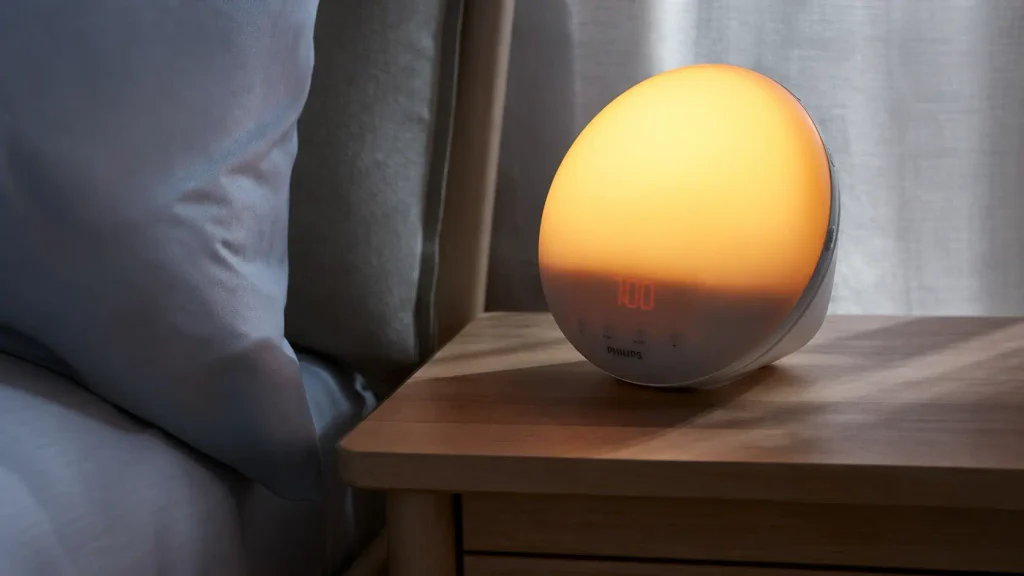
The Philips SmartSleep sits on the exact opposite end of the spectrum.
There is no linen fabric here.
There is certainly no smartphone app either.
It is built from smooth, hard plastic with a slightly glossy finish.
The large ring design honestly looks a bit like a futuristic glowing donut.
It stands out as a dedicated, highly functional piece of hardware.
Philips leaned heavily into clinical research for this model.
They outfitted it with an incredibly powerful light capable of reaching 300 Lux.
The colored simulation is strikingly realistic.
It shifts from a deep, warm morning red through orange, eventually hitting a bright yellow.
You also get five built-in natural sounds and a classic FM radio.
The biggest gripe is the physical interface.
Every setting must be adjusted via small, touch-sensitive icons on the outer rim.
Navigating the menu to set a backup alarm requires a lot of tapping.
The touch-to-snooze feature on the front panel also lacks the satisfying click of a real button.
But once it is set, it runs flawlessly.
No Wi-Fi, no firmware updates, and absolutely no monthly fees required.
👉 Check Current Price & Deals for Philips SmartSleep on Amazon
The “Save Your Marriage” Add-On
Here is a highly practical scenario most people forget when shopping for sleep tech.
What happens if you wake up at 6:00 AM, but your partner sleeps until 7:30 AM?
These wake-up lights are designed to flood the entire room with brightness.
It will absolutely wake up whoever is sleeping next to you.
Do not let a new gadget start a morning fight.
Pair your clock with a high-quality, zero-pressure sleep mask.
I highly recommend keeping something like the Manta Sleep Mask on your partner’s nightstand.
Its 3D eye cups block out 100% of ambient light without putting pressure on their eyelids.
You get to enjoy your gentle sunrise, and they sleep undisturbed in a personal blackout zone.
👉 Check Current Price & Deals for Manta Sleep Mask on Amazon
Which One Actually Fits Your Routine?
Deciding between these two comes down to your bedtime habits.
Grab the Hatch Restore 3 if you view sleep as a wellness practice.
It is perfect if you love curating phone routines and appreciate organic materials like fabric.
You just have to be okay with the subscription model for the best audio content.
On the flip side, the Philips SmartSleep is for the true pragmatist.
It is the ultimate “set it and forget it” device.
It delivers a blindingly effective, clinically backed light to drag you out of bed on dark mornings.
If you strictly refuse to pay monthly fees for an alarm clock, the Philips is virtually unkillable.
Common Questions Before You Buy
Why does light work better than a standard audio alarm?
It comes down to basic biology.
Waking up to a loud noise spikes your heart rate while you are still in deep sleep.
This leads to that heavy, disoriented feeling known as sleep inertia.
According to the American Academy of Sleep Medicine (AASM), abrupt shifts in our circadian rhythm can significantly impact our mood.
A gradual increase in light naturally signals your brain to suppress melatonin before you even open your eyes.
Will these clocks remember my alarm if the power goes out?
Both devices require a constant connection to a wall outlet.
The Philips model features a small internal memory backup to preserve your settings during a brief outage.
However, the light itself won’t function without wall power.
The Hatch relies entirely on its connection to your home network.
If you live in an area prone to spring storms, always keep a backup alarm on your phone.
Is the Hatch Restore 3 useless without the subscription?
Not at all.
You can absolutely use it without paying a dime extra.
You will always have access to the core custom sunrise alarm features and solid light colors.
You just miss out on the expanding library of premium meditations.
Wrapping Up:
The time change is coming whether we like it or not.
But transitioning your body with a dedicated wake-up light genuinely turns a rough morning into a manageable one.
👉 Check the Current Price for the Hatch Restore 3 on Amazon
👉 Check the Current Price for the Philips SmartSleep on Amazon
How do you usually handle the “spring forward” transition? Let me know your survival strategies in the comments below!
Want more recommendations? Head back to our homepage to see all our 2026 everyday picks.