As an Amazon Associate, I earn from qualifying purchases. This post may contain affiliate links, meaning I get a commission if you decide to make a purchase through my links, at no cost to you.
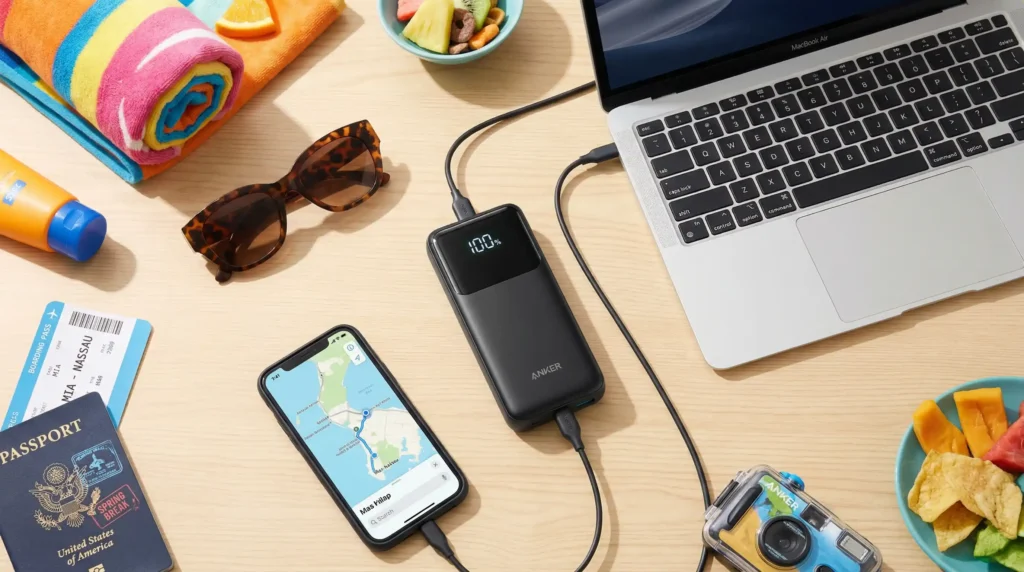
Finding the best portable charger for laptop and phone usually starts with the exact same airport scene.
You are hovering near a crowded gate with a red battery icon flashing on your screen.
Every nearby wall outlet is either taken or so loose that your heavy charging brick falls straight to the carpet.
Grabbing a cheap, pocket-sized phone pack from a terminal newsstand will not solve that problem.
Laptops demand serious, sustained wattage.
If your charger cannot deliver high power under proper USB Power Delivery profiles, your computer will barely stay on, let alone charge.
Three models dominate the laptop-grade category right now: the Anker 737 (PowerCore 24K), the UGREEN 145W Power Bank (25,000mAh), and the Baseus Blade 100W.
Here is how their physical shapes, charging limits, and real-world trade-offs actually compare.
Quick Comparison: Specs, Output, and Pricing
| Model | Core Specs & Output | Where to Check Pricing |
|---|---|---|
| Anker 737 PowerCore 24K | 24,000mAh (86.4Wh) / 140W Peak PD 3.1 / 22.2 oz (630g) | View on Amazon |
| UGREEN 145W Power Bank | 25,000mAh (90Wh) / 100W + 45W Dual Ports / 18.1 oz (513g) | View on Amazon |
| Baseus Blade 100W | 20,000mAh (74Wh) / 100W Peak / 0.7-in Slim / 17.3 oz (490g) | View on Amazon |
1.Anker 737 PowerCore 24K: Uncompromising Single-Port Speed
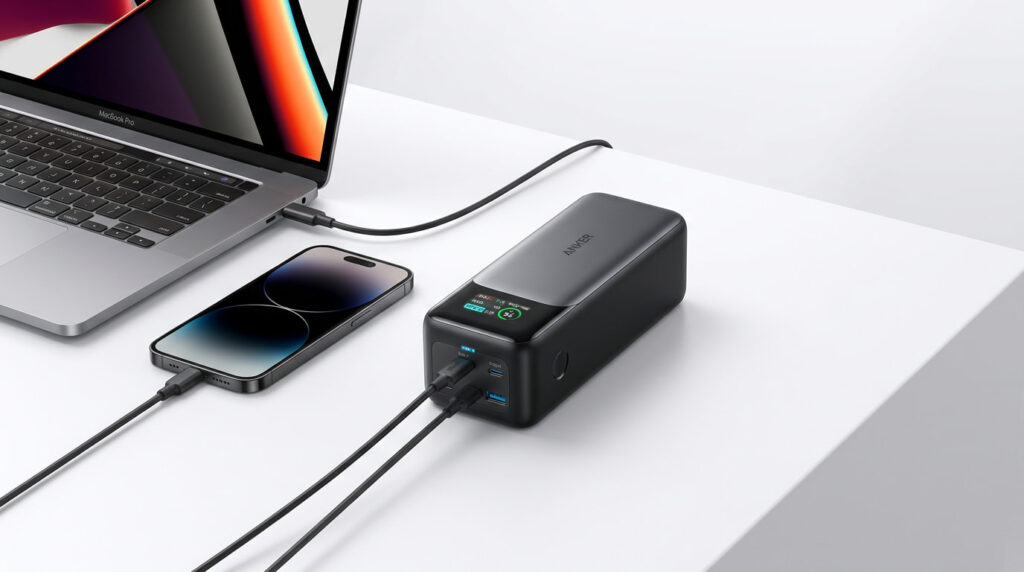
Anker designed this battery around the USB Power Delivery 3.1 standard.
While older travel packs top out at 100W, the Anker 737 pushes up to 140W from either USB-C connection.
That means machines like a 16-inch MacBook Pro or high-draw PC workstations receive true full-speed power, rather than a slow emergency trickle.
Its most notable feature is the integrated full-color smart display.
Instead of making you guess with four vague indicator dots, the screen reports live input and output wattage per port, cell health, and an estimated runtime countdown.
Recharging the battery itself is just as fast.
When plugged into a compatible high-wattage wall adapter, the 24,000mAh reserve refuels from empty in roughly an hour.
The compromise comes down to physical bulk.
At 22.2 ounces (630 grams) and shaped like an upright prism, this is a dense piece of hardware.
It stands upright on a cafe table or slips into a backpack bottle pocket, but it is far too heavy to carry comfortably in a light tote bag.
👉 Check Current Price & Deals for Anker 737 PowerCore 24K on Amazon
2.UGREEN 145W Power Bank: Built for Simultaneous Charging

If your daily routine involves running two screens simultaneously, the UGREEN 145W makes a very strong case as the best portable charger for laptop and phone.
Where Anker focuses on single-port speed, UGREEN engineered this 25,000mAh pack around stable dual-device delivery.
Many multi-port batteries cut their speeds to a crawl the second you connect a second accessory.
UGREEN avoids that by hard-coding a dedicated 100W rail on USB-C1 alongside a secondary 45W rail on USB-C2.
That split makes life much easier if you work from both a laptop and a phone during long layovers.
Your 100W notebook keeps running full speed while your smartphone fast-charges at 45W, without random disconnects or cycling screens.
At 90Wh, its internal capacity also sits right under federal airline limits, giving you the maximum allowable energy without paperwork.
The curved exterior sits completely flat on an airline tray table.
Just keep in mind that it swaps Anker’s color telemetry display for a standard numeric LED percentage readout.
Input charging also caps at 65W, so bringing this pack back to full from empty takes about two hours.
👉 Check Current Price & Deals for UGREEN 145W Power Bank on Amazon
3.Baseus Blade 100W: The Flat-Pack Solution for Commuters

Most laptop power banks are thick bricks that cause awkward bulges in slim bags and portfolios.
The Baseus Blade takes a completely different path, spreading its 20,000mAh capacity across a flat, 0.7-inch wafer silhouette.
Because it matches the footprint of a small tablet or notebook, it slides flush next to your computer inside the very same sleeve.
That wide surface area keeps it from sliding off airline tray tables during light turbulence.
The top panel features an anti-slip texture alongside a clean display showing remaining percentage, voltage, and charge times.
You get two USB-C ports and two USB-A ports.
Connecting two devices splits output into a 65W and 30W configuration.
The main boundary is total capacity.
At 74Wh (20,000mAh), it holds roughly 15% to 18% less total juice than the Anker or UGREEN options, making it ideal for daily office commutes rather than multi-day off-grid travel.
👉 Check Current Price & Deals for Baseus Blade 100W on Amazon
The Essential Pairing: Anker 735 65W GaN Wall Charger
Here is the detail most brands hide in the fine print: none of these high-capacity power banks include a wall adapter in the box.
If you try to recharge a 25,000mAh battery using an old 5W or 20W phone cube, it can take anywhere from six to ten hours to fill up.
That ruins the whole point of a travel battery when you only have a quick hotel layover before your next flight.
The best companion gear for any of these packs is a compact GaN wall plug like the Anker 735 Charger (GaNPrime 65W) (Check Anker 735 Price on Amazon).
It uses Gallium Nitride semiconductors to fit 65W of output into a foldable plug roughly the size of an AirPods case.
With two USB-C ports and one USB-A port, it lets you rapid-charge your power bank at its full input limit while still juicing your phone directly from the same wall socket.
Tucking this tiny plug into your gear pouch cuts your battery refill time down to under two hours, ensuring your portable setup is always topped off before boarding.
How to Choose the Best Portable Charger for Laptop and Phone
Finding the right battery comes down to which devices you carry and how much room is left in your bag.
The Power User Pick: Anker 737
Get this if your daily driver is a 15- or 16-inch high-performance notebook.
Heavy rendering or compiling burns through battery rapidly.
The 140W single-port speed and rapid one-hour self-recharge easily make up for its heavier prism shape.
The Dual-Screen Commuter: UGREEN 145W
Choose this if you routinely work with a laptop and a phone simultaneously.
Its hard-wired 100W and 45W split charges both devices at full speed without cutting power to either.
Plus, its 90Wh capacity squeezes the maximum legal juice allowed onto an airplane.
The Minimalist Sleeve: Baseus Blade 100W
Pick this if you carry a slim briefcase or a structured notebook sleeve.
Standard battery bricks create an ugly bulge in thin bags.
The Blade delivers reliable 65W to 100W laptop power in a flat, notebook-style profile that takes up zero extra volume.
Frequently Asked Questions
Are these power banks allowed on commercial flights?
Yes. According to the FAA PackSafe guidelines, lithium-ion batteries rated at 100 Watt-Hours (Wh) or less are permitted without special airline approval.
The TSA guidelines on portable chargers require all power banks to stay in carry-on baggage only.
They are strictly prohibited in checked luggage due to cargo fire safety rules.
All three models fall safely under this legal threshold:
- Anker 737: 86.4Wh
- UGREEN 145W: 90Wh
- Baseus Blade 100W: 74Wh
How many full charges do these batteries deliver in real-world use?
Due to standard voltage step-up conversion and normal heat dissipation, portable power packs lose roughly 20% to 30% of their rated capacity during energy transfer.
In practical use:
- A 24,000mAh to 25,000mAh battery (Anker and UGREEN) provides about 1.1 to 1.3 full charges for a 13-inch or 14-inch laptop, or 4 to 5 full recharges for a standard phone.
- A 20,000mAh battery (Baseus) provides about 0.8 to 1.0 full charge for a 13-inch laptop, or 3 to 4 phone recharges.
Can you recharge the power bank while charging other devices?
Yes, this is known as pass-through charging.
Both the Anker 737 and UGREEN 145W support dynamic power routing.
You can plug the power bank into a wall outlet and run a secondary cable out to your phone or notebook.
Keep in mind that total incoming wattage will be divided between recharging the battery cells and powering your connected devices.
Final Thoughts: Reclaim Your Mobility
Camping out on airport carpet just to sit next to a worn-out wall socket ruins any travel day.
Investing in the best portable charger for laptop and phone turns your setup into an entirely self-sufficient workstation, whether you are waiting out a delayed flight or working from a park bench.
Take a quick look at your bag’s available space, match it to your screen setup, and stop letting low-battery warnings dictate where you sit.
If you are ready to upgrade your travel kit before your next trip:
- Pick up the Anker 737 on Amazon for absolute maximum 140W laptop-grade power.
- Grab the UGREEN 145W on Amazon for the most reliable dual-device charging split.
- Choose the Baseus Blade 100W on Amazon for an ultra-flat profile that slides into any slim sleeve.
- Don’t forget the Anker 735 65W GaN Charger on Amazon to cut your battery refill time down to under two hours.
Want more recommendations? Head back to our homepage to see all our 2026 everyday picks.