As an Amazon Associate, I earn from qualifying purchases. This post may contain affiliate links, meaning I get a commission if you decide to make a purchase through my links, at no cost to you.
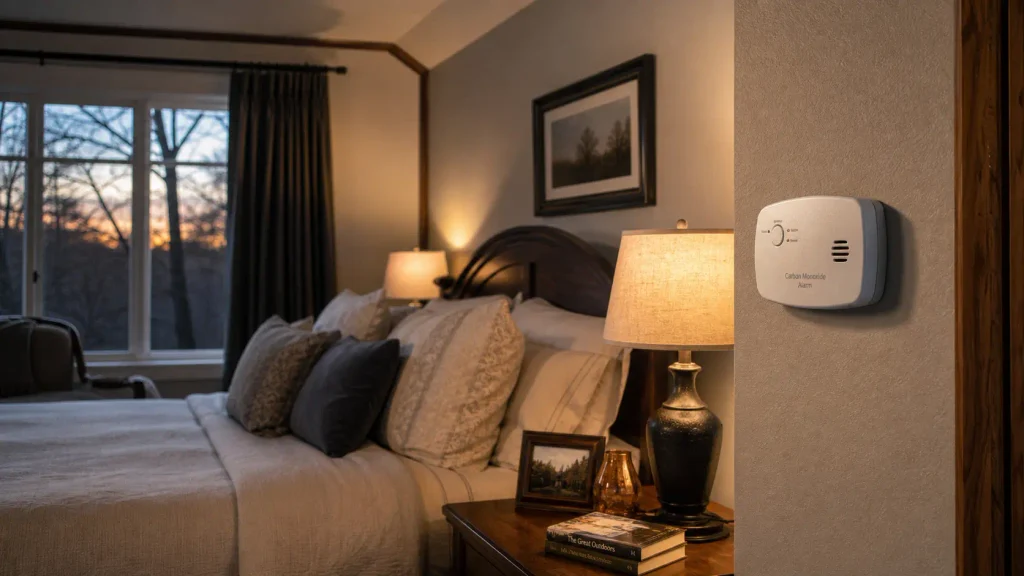
Finding the best carbon monoxide detector for bedroom safety becomes urgent the moment autumn temperatures drop and your home furnace kicks on for the first time.
Every fall, the ritual repeats across millions of American homes: you walk over to the thermostat, flip the switch from “Cool” to “Heat,” and wait for that familiar, dusty warmth to drift through the vents.
That comforting sound of your furnace firing up marks the start of the colder months.
It also opens the most critical window of the year for indoor air safety.
According to safety alerts from the Consumer Product Safety Commission (CPSC), unintentional, non-fire-related carbon monoxide incidents surge as temperatures fall. Aging heating furnaces, cracked heat exchangers, and blocked exhaust flues are primary sources.
Carbon monoxide is completely invisible, odorless, and tasteless.
You cannot rely on your senses to wake you up if a leak develops at night. Sleeping occupants simply slip from sleep into unconsciousness without noticing an issue.
That is why the National Fire Protection Association (NFPA 72 Standard) advises installing a certified carbon monoxide alarm outside every separate sleeping area, inside each bedroom, and on every occupied level of the house.
If your current alarms are seven to ten years old, their internal chemical sensors have likely expired.
The safety standard requires replacing aging units to ensure your sleeping quarters remain protected.
Here is an analysis of three widely trusted models built for different bedroom layouts, based directly on manufacturer specifications and national safety standards.
Quick Comparison
| Model | Core Official Advantage | View on Amazon |
|---|---|---|
| First Alert CO710 | 10-year sealed battery with digital temperature and CO display; tabletop or wall mount | View on Amazon |
| X-Sense SC07-W | RF wireless interlink connects all rooms; dual smoke and CO detection | View on Amazon |
| Kidde KN-COPP-3 | AC wall plug with battery backup; live LED display with peak event memory | View on Amazon |
1. First Alert CO710: The Zero-Wiring Bedside Companion
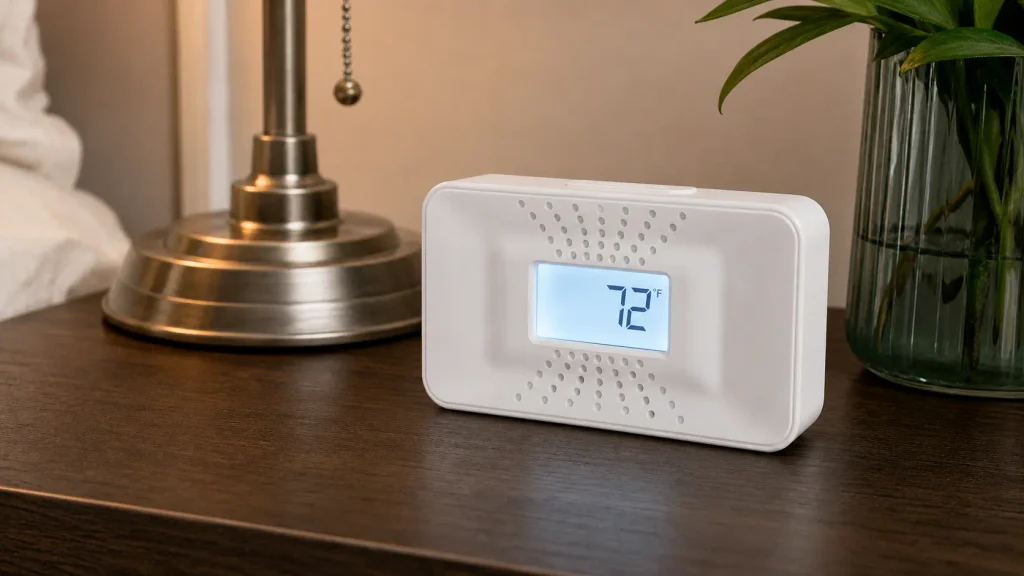
If you rent an apartment or want bedroom protection without drilling holes into drywall, the First Alert CO710 Carbon Monoxide Alarm is one of the cleanest options available.
Unlike standard contractor alarms designed solely for ceiling brackets, this model has a flat base engineered to sit upright on a nightstand, dresser, or floating shelf.
According to First Alert’s official technical specifications, the unit runs on a built-in 10-year sealed lithium power cell.
Once you slide the activation switch on the back, the internal battery provides continuous monitoring for a full decade. You never have to buy replacement 9-volt batteries or deal with late-night low-battery chirps.
The front-facing screen pulls double duty in sleeping areas. Under normal conditions, it displays the ambient room temperature.
If carbon monoxide is present, the sensor automatically overrides the temperature and displays the concentration level in parts per million (PPM). If dangerous gas levels accumulate, an 85-decibel horn sounds to wake heavy sleepers.
The unit carries full certification under the UL 2034 Residential Safety Standard, ensuring reliable electrochemical sensing without false triggers from normal household steam.
In everyday standby mode, the screen remains completely unlit so it will not disturb dark bedrooms. Checking the room temperature at night simply requires tapping the front button to trigger a soft backlight.
👉 Check Current Price & Deals for First Alert CO710 on Amazon
2. X-Sense SC07-W: Whole-Home Wireless Interlink for Closed Doors
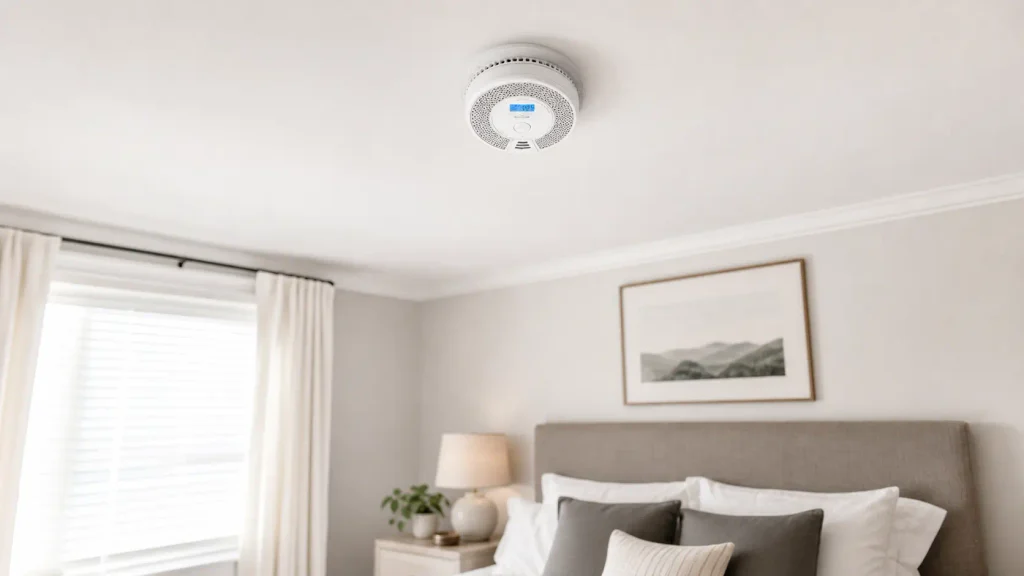
In multi-level houses where bedrooms are upstairs and the heating furnace sits in the basement, sound travel is a major safety obstacle.
A heavy, closed bedroom door can reduce an alarm’s audible volume by up to 20 decibels. That acoustic barrier can make a basement alarm difficult to hear from a second-story master bedroom.
The X-Sense SC07-W Wireless Alarm bridges that distance using dedicated radio-frequency (RF) wireless interconnection.
According to X-Sense documentation, you can wirelessly connect multiple alarms together without touching your home Wi-Fi network.
When a unit in the basement or utility closet detects smoke or carbon monoxide, every linked alarm throughout the house sounds at the same moment. This gives sleeping family members immediate notice, no matter where the hazard starts.
The unit houses both a photoelectric smoke sensor and an electrochemical CO sensor inside a single ceiling bracket.
Manufacturer data confirms that the sealed lithium battery lasts for ten years of continuous operation. The housing also features internal micro-mesh screens around the intake vents to prevent small insects from causing accidental alarms.
Because this is a dual-threat combination device with internal RF antennas, it has a broader ceiling profile than single-purpose sensors, making it strictly intended for overhead wall or ceiling mounting.
👉 Check Current Price & Deals for X-Sense SC07-W on Amazon
3. Kidde KN-COPP-3: Continuous Outlet Power with Peak Memory
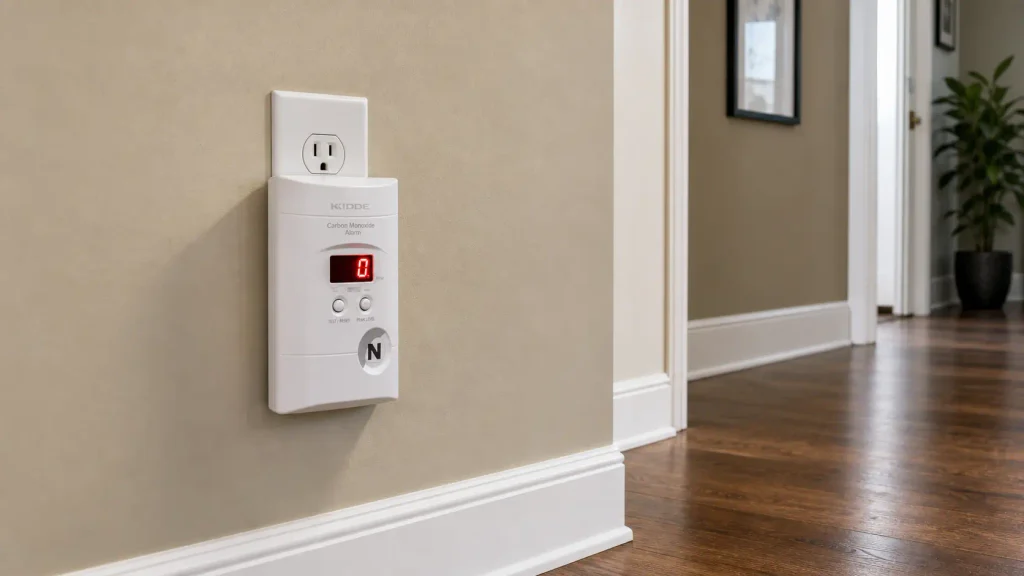
For central hallways outside bedroom clusters, the Kidde KN-COPP-3 Plug-In Alarm is an enduring standard across American homes.
It plugs straight into any standard 120-volt wall outlet. If your accessible socket is hidden behind furniture, a six-foot pull-out extension cord stored inside the rear frame lets you position the device on a nearby table.
The defining feature of this Kidde model is its constant numeric digital display, which updates ambient readings every 15 seconds.
The Centers for Disease Control and Prevention (CDC) points out that low-level carbon monoxide exposure often mimics mild viral illnesses, causing dull morning headaches, dizziness, and fatigue.
The KN-COPP-3 includes a dedicated “Peak Level” button. Pressing this button displays the highest CO concentration recorded by the unit since its last reset.
This enables homeowners to identify small, intermittent gas releases from furnace ignition cycles before concentrations ever climb high enough to trigger an emergency siren.
The unit utilizes a front-loading 9-volt battery backup to maintain protection during winter power outages. The backup battery requires routine annual replacement, making this model best suited for homeowners who want direct outlet power and active data logging.
👉 Check Current Price & Deals for Kidde KN-COPP-3 on Amazon
Seasonal HVAC Companion: Filtrete 16x25x1 MPR 1500 Air Filter
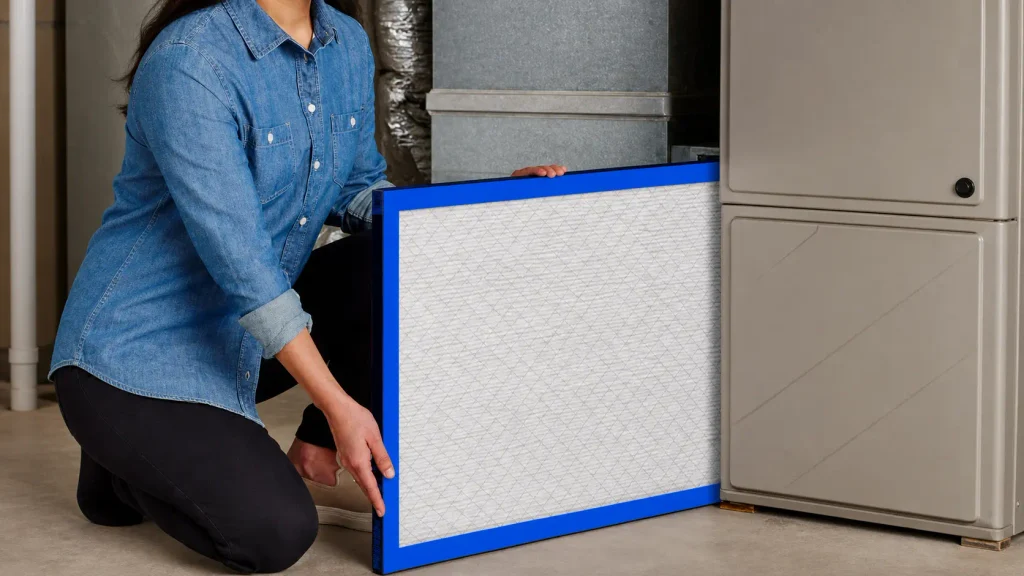
While alarms alert you to escaping gas, proper airflow helps keep your heating equipment running safely in the first place.
Before running your heat constantly this winter, replace dirty intake filters with a fresh Filtrete 16x25x1 MPR 1500 Air Filter.
Restricted furnace airflow forces your blower motor to work harder, which causes heating exchangers to run at elevated temperatures.
Over time, this thermal stress can cause the metal heat exchanger to develop hairline cracks, allowing combustion gases to bleed directly into your home’s air supply.
A fresh pleated filter maintains proper intake airflow balance while trapping seasonal dust and fine particles before they cycle through your bedroom vents.
👉Check Current Price & Deals on Amazon
How to Choose the Best Carbon Monoxide Detector for Bedroom Layouts
Your home layout should determine how you deploy these devices.
If you live in an apartment or rental property, the freestanding First Alert CO710 provides verified protection without requiring wall anchors or permanent changes. It sits right beside your bed and packs into a box when you move.
For two-story colonials or homes with finished basements, relying on standalone alarms creates dangerous sound blind spots. Installing interconnected units like the X-Sense SC07-W ensures that an issue in the furnace room immediately sounds the alarm upstairs.
If your floorplan centers around an open hallway near bedroom entrances, the Kidde KN-COPP-3 offers continuous visibility. Walking past a bright digital screen that confirms zero PPM provides effortless reassurance throughout the heating season.
Heating Season FAQ
Where should you place a carbon monoxide detector in a bedroom?
Install alarms at breathing height, roughly three to five feet off the floor, or place them on an open nightstand.
Carbon monoxide has a molar mass nearly identical to air, meaning it distributes evenly throughout an enclosed space rather than settling near baseboards or rising immediately to the ceiling.
Keep sensors at least five feet away from direct forced-air supply registers to ensure moving air currents do not blow gas away from the sensor vents.
How do you tell the difference between an emergency alarm and an end-of-life chirp?
An active carbon monoxide emergency triggers a continuous pattern of four rapid, loud horn beeps followed by a brief pause, accompanied by a flashing red light.
An end-of-life alert sounds as a single chirp every 30 to 60 seconds, usually paired with an “End” or error reading on digital models.
When you hear this spaced chirp, the internal chemical sensor has oxidized past its certified lifespan, and the entire unit must be replaced.
Can a cracked furnace heat exchanger leak carbon monoxide only when the heat runs?
Yes, a cracked heat exchanger typically leaks only while the furnace burners fire and the circulating blower engages.
This intermittent operation is why detectors with peak-level memory functions are useful. They log temporary gas spikes that dissipate before reaching the continuous threshold required to sound a full emergency alarm.
Final Safety Checklist
Before sustained freezing weather arrives, take twenty minutes to walk your halls and check your sleeping quarters.
Look at the manufacture date stamped on the back of each unit, and replace anything that has passed the seven-to-ten-year mark.
Press and hold the test buttons to confirm that the internal horns sound loud and clear.
Whether you choose a nightstand-ready model like the First Alert CO710, a whole-home interconnected array with the X-Sense SC07-W, or an outlet-mounted unit like the Kidde KN-COPP-3, ensuring every bedroom zone has working coverage is the most effective safety step you can take this season.
Investing in the best carbon monoxide detector for bedroom protection is a small, five-minute task that delivers total peace of mind all winter long.
- Check Current Price & Deals on the First Alert CO710 on Amazon
- Check Current Price & Deals on the X-Sense SC07-W on Amazon
- Check Current Price & Deals on the Kidde KN-COPP-3 on Amazon
Want more recommendations? Head back to our homepage to see all our 2026 everyday picks.