As an Amazon Associate, I earn from qualifying purchases. This post may contain affiliate links, meaning I get a commission if you decide to make a purchase through my links, at no cost to you.
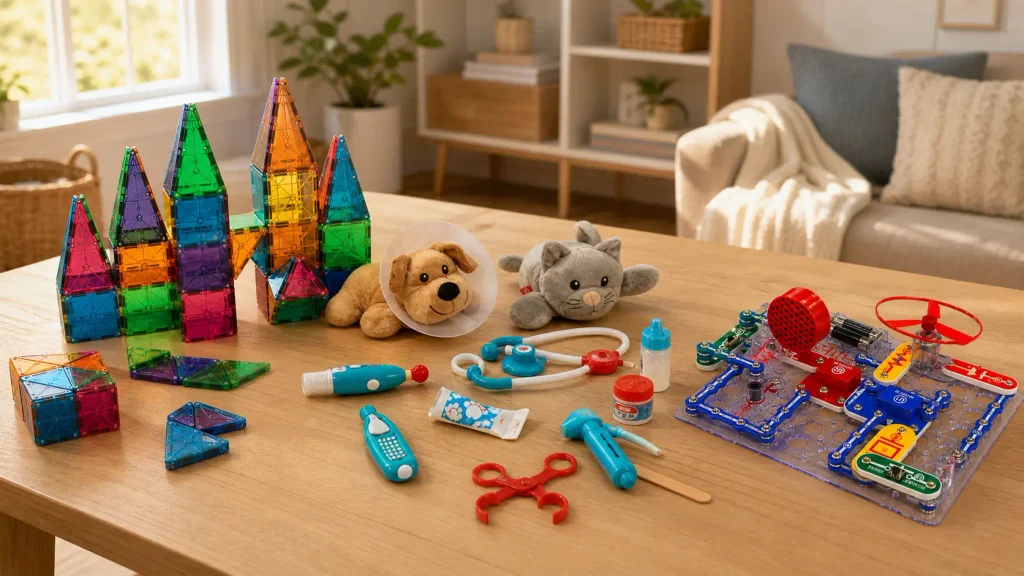
Finding the right screen-free gifts for kids can be harder than it sounds. Children have different interests, and the best toys are often the ones that keep them curious, creative, and entertained long after the wrapping paper is gone.
One child might spend an entire afternoon building a castle from magnetic tiles. Another would rather look after a pretend puppy, while an older child might be more interested in figuring out how an electronic motor works.
This guide brings together three Amazon picks that offer very different kinds of play: creative construction, imaginative role-playing, and hands-on electronics. Each gives children something to explore without making a screen part of the activity.
Age matters, too. The Consumer Product Safety Commission’s toy-safety guidance recommends choosing toys that match children’s ages, interests, and abilities. Parents should also pay attention to small-parts warnings, especially when younger siblings share the same play space.
Amazon Toy Gifts for Kids: Three Different Kinds of Play
| Product & Key Details | Where It Shines (and Its Trade-off) | Where to Buy |
|---|---|---|
| MAGNA-TILES Classic 100-Piece Set — 100 magnetic pieces, ages 3–99 (manufacturer's suggested age) | Open-ended construction and creative exploration; needs room for larger builds and a place to store the pieces | View on Amazon |
| Melissa & Doug Examine & Treat Pet Vet Play Set — 24 pieces; ages 3+ | Animal care, storytelling, and pretend veterinary visits; best for children who enjoy role-playing | View on Amazon |
| Snap Circuits Jr. SC-100 — 30 parts, 100+ projects, ages 8+ | Hands-on electrical experiments with illustrated instructions; requires two AA batteries and some patience | View on Amazon |
MAGNA-TILES Classic 100-Piece Set: Creative Building
Some toys have a clear beginning and ending. You put the pieces together, finish the project, and eventually move on to something else.
Magnetic building tiles are different. A child can build a house in the morning, turn it into a castle in the afternoon, and pull everything apart the next day to start again.
The MAGNA-TILES Classic 100-Piece Set is designed around this kind of open-ended play. It contains 100 magnetic geometric pieces, including squares and several types of triangles that connect to form towers, bridges, houses, and more elaborate structures.
The manufacturer’s suggested age range is 3–99 years. This is the brand’s published age label, not a developmental guarantee or safety certification for every age group.

The construction is more considered than it might initially appear. MAGNA-TILES uses food-grade MABS plastic, which the manufacturer describes as free from BPA, phthalates, and latex.
The pieces also feature an internal lattice structure designed to help prevent cracking. Fastening rivets are used to help keep the magnets secured inside the tiles.
That matters in a toy designed to be pulled apart and reassembled repeatedly. The magnetic connections are simple enough for younger builders to experiment without complicated instructions or specialized tools.
Another advantage is compatibility. MAGNA-TILES pieces can be combined with other sets from the same brand, so children who already own a smaller collection can use additional shapes to expand their creations.
There is a practical consideration before buying, though. The packaged set weighs 7.4 pounds and measures 12 × 9 × 3 inches, so families should have somewhere to keep the pieces together and enough space for larger constructions.
It may also be less appealing to children who prefer character-based toys, specific missions, or a ready-made storyline. Magnetic tiles leave most of the creative direction to the child, which is part of their appeal but also a matter of personal preference.
For children who enjoy inventing their own structures or working alongside siblings, this is the strongest building option in the group. It offers plenty of room for new ideas without requiring families to keep buying different themed sets.
View MAGNA-TILES Classic 100-Piece Set on Amazon
Melissa & Doug Pet Vet Set: Pretend Play
Some children would rather take care of a stuffed animal than build something from scratch. They give their toys names, make up little stories, and turn ordinary household situations into elaborate games.
The Melissa & Doug Examine & Treat Pet Vet Play Set gives that imagination a more complete setting.
The 24-piece collection includes a plush dog and cat, together with pretend veterinary equipment. Children get a stethoscope, thermometer, syringe, ear scope, tweezers, and clamp.
There are also bandages, a cast, pretend treatments, and a reusable examination checklist. The manufacturer recommends the set for children ages 3 and up, with particular appeal for preschoolers around ages three to six.

What makes this set more engaging than a simple collection of toy medical instruments is the combination of the animals and accessories. A child can examine the puppy, decide that the kitten needs a bandage, and use the checklist to create a pretend appointment.
The included tote bag gives all the pieces a convenient place to go after playtime. Children can also bring their own stuffed animals into the game, giving the set more possibilities than the two included plush patients alone.
This is a different kind of experience from building or solving a puzzle. The focus is on caring for something, creating a situation, and deciding what happens next.
It can also become a shared activity. One child can play veterinarian while another brings in a pet for a checkup, with the roles changing as the story develops.
The limitation is that this is a fairly specific kind of play. Children who aren’t particularly interested in animals or pretend medical visits may not get much out of it, regardless of how many accessories are included.
Parents should also keep the smaller components away from children under three. The tote bag makes cleanup easier, but it doesn’t replace proper storage or age-appropriate supervision.
For a preschooler who loves puppies, kittens, stuffed animals, and make-believe, this is a more personal choice than another generic toy set. It gives the child an entire little scenario to explore, complete with characters, tools, and a reason to keep the story going.
View Melissa & Doug Examine & Treat Pet Vet Play Set on Amazon
Snap Circuits Jr. SC-100: Hands-On Science
Some children eventually start asking questions that ordinary toys can’t answer. Why does a light turn on? What makes a fan spin? How does a doorbell work?
Snap Circuits Jr. SC-100 is designed for children who want to explore those questions with their own hands.
The kit introduces basic electronics through 30 snap-together parts mounted on plastic modules. Instead of working with exposed wires or soldering equipment, children connect the pieces to a plastic base and follow illustrated instructions to build functioning electrical circuits.
The manufacturer describes more than 100 projects for the SC-100. Activities involve different circuit combinations and components that demonstrate basic electrical principles.
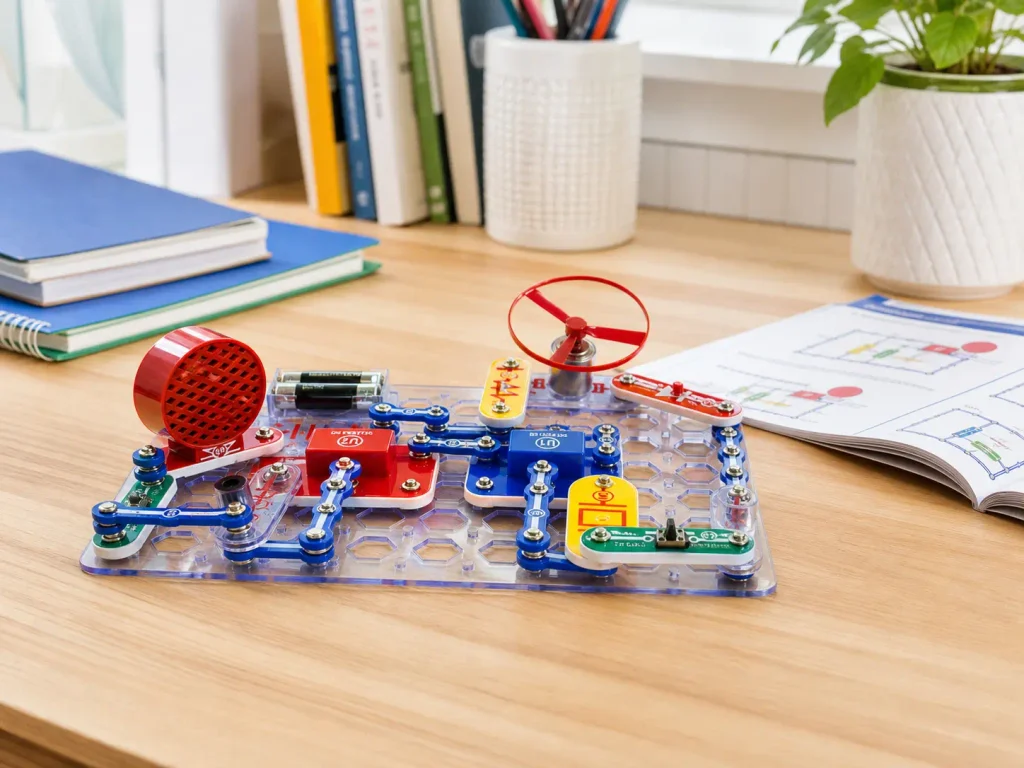
The interesting part is the immediate feedback. A correctly connected circuit can produce light, sound, or movement, giving children something they can actually observe rather than simply reading an explanation of how electricity works.
The manufacturer recommends the kit for ages 8 and up. Children need to be comfortable following diagrams and handling small components, although parents can help younger or inexperienced users get started.
One detail worth remembering is that the kit requires two AA batteries, which are not included. Having them ready before giving the gift saves the disappointment of opening the box and discovering that the first experiment has to wait.
The kit also has a learning curve. A child who expects every toy to work immediately may become frustrated when a circuit doesn’t connect properly the first time.
For a child who enjoys figuring things out, however, checking the connections and trying again is part of the experience. It is a more satisfying activity for someone who likes working through a problem than for someone who simply wants a toy that starts playing as soon as it is switched on.
The safety instructions deserve attention, too. Children should never connect the kit to household electrical outlets, and the manufacturer warns against touching the motor or fan while they are operating.
For a child who enjoys science, experiments, and understanding how everyday electronics work, Snap Circuits Jr. offers a different kind of challenge from the other two toys. It is the strongest choice for the older child in this guide, particularly one who likes seeing a project work after putting the pieces together.
View Snap Circuits Jr. SC-100 on Amazon
After the Gift Is Opened: Storage, Setup, and When to Skip a Toy
The way a toy is stored can make a surprising difference in how often it gets used. Magnetic tiles need a place where children can spread out their creations, while small pretend-play accessories are less likely to disappear when they have a designated home.
For the MAGNA-TILES set, a shallow storage bin or dedicated building tray makes cleanup easier. A small divided parts organizer with a secure lid is particularly useful for Snap Circuits, where keeping individual components together can save time when a child returns to an unfinished project.
The Pet Vet set already includes a tote bag, so there is little reason to buy an elaborate storage accessory for it. Keeping the plush animals and smaller instruments together is usually enough.
A dedicated play area doesn’t need to be a separate room. Even a small table with good lighting and a few accessible containers can make it easier for children to return to an unfinished activity.
There is one situation in which I would skip all three products: when the purchase is based mainly on what an adult considers educational rather than what the child actually enjoys.
A science kit won’t automatically appeal to every curious child, and a large construction set won’t become interesting simply because it contains plenty of pieces. It is better to pay attention to what the child chooses during ordinary play.
That is usually a much better guide than the learning claims printed on a toy’s packaging.
What Parents Should Know About Screen-Free Gifts for Kids
How do you choose a toy when you don’t know a child’s interests?
When you don’t know a child’s interests well, prioritize age suitability and toys that offer more than one way to play rather than relying on a narrow character theme or a passing trend.
Open-ended construction sets can work well for some children because they don’t require a particular storyline. However, even a versatile building set is a poor choice for someone who has little interest in construction.
Asking the child’s parents what they currently enjoy is often the simplest way to avoid an unsuitable gift. Knowing whether a child prefers animals, building, puzzles, or science activities is more useful than guessing from age alone.
Are educational toys better than traditional pretend-play toys?
Educational toys are not automatically better than pretend-play toys because both can encourage curiosity, creativity, and problem-solving through different kinds of activities.
An electronics kit introduces basic concepts through experimentation, while a veterinary play set gives children a chance to invent stories and explore familiar situations. Magnetic building tiles offer another experience, allowing children to experiment with shapes and structures without following a fixed lesson.
The better choice depends on the child, not the educational label. A toy that holds a child’s attention and encourages exploration is more useful than one that sounds impressive but stays unopened.
What should parents consider when siblings share toys?
Parents should consider each child’s age and ability to handle small components, especially when older children own toys that younger siblings may want to play with.
A magnetic tile set and a pretend pet kit may be easier to share in a family playroom, but individual pieces still need to be stored appropriately. Snap Circuits is intended for older children and requires more careful handling of its electronic components.
The CPSC’s guidance on small parts and children’s products explains the restrictions and choking-hazard labeling that parents should understand before choosing toys for households with toddlers.
The Best Amazon Toy Gift Depends on the Child, Not the Box
If I had to choose one of these three for children who enjoy creative construction, the MAGNA-TILES Classic 100-Piece Set would be my overall pick. Its open-ended design gives children room to invent their own projects, and the pieces can be combined with other compatible MAGNA-TILES collections as their ideas grow.
The Melissa & Doug Pet Vet Set is the more personal choice for preschoolers who love animals and pretend play. Snap Circuits Jr. SC-100 is better suited to older children who are ready to explore electronics and enjoy working through hands-on challenges.
There isn’t one toy that will make every child happy. A thoughtful gift starts with paying attention to what a child already likes, then choosing something that gives that interest room to grow.
View MAGNA-TILES Classic 100-Piece Set on Amazon
Want more recommendations? Head back to our homepage to see all our everyday picks.