As an Amazon Associate, I earn from qualifying purchases. This post may contain affiliate links, meaning I get a commission if you decide to make a purchase through my links, at no cost to you.
Late February kicks off the American home improvement season, and reliable laser measures and wall scanners are the fastest way to avoid costly renovation mistakes. Wrestling a buckling metal tape measure or knocking on drywall turns simple upgrades into exhausting guesswork.
Blind drilling carries far worse consequences than crooked picture frames. Puncturing a hidden wire or copper pipe risks severe shock or flooding, which is why federal home electrical safety guidelines emphasize verifying concealed utilities before driving fasteners.
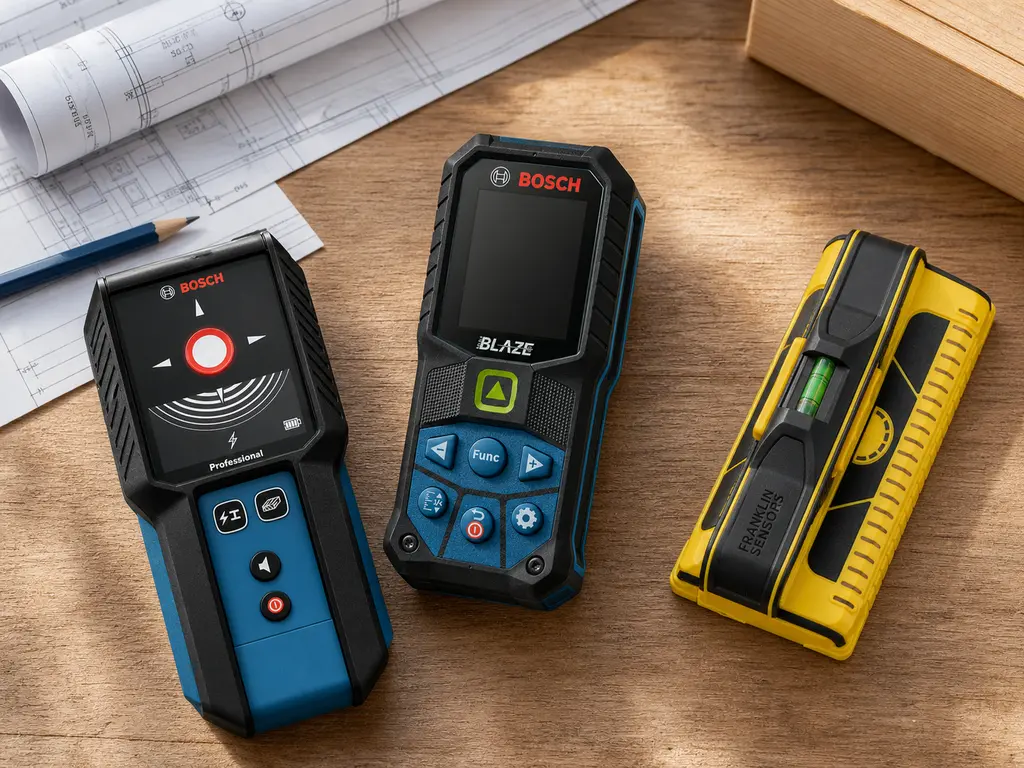
For sunlit room layouts and high ceilings, the Bosch BLAZE GLM165-27CG stands out as our current optical distance champion. It replaces floppy metal blades with instant, one-handed millimeter precision.
When mapping what hides behind walls, the Bosch GMS120-27 offers unmatched multi-material hazard detection. Meanwhile, the Franklin Sensors ProSensor M210 delivers instant, calibration-free stud location for rapid drywall mounting.
Precision at a Glance: Comparing Top Layout and Detection Tools
| Product & Key Spec | Where It Shines (and Its Trade-off) | Where to Buy |
|---|---|---|
| Bosch BLAZE GLM165-27CG (165 ft / Green Diode) | Bright green laser with ±1/16 in. accuracy, tilt sensor, and Bluetooth app sync; drains AA batteries faster than red lasers. | View on Amazon |
| Bosch GMS120-27 (Multi-Mode / 4.7 in. Depth) | Distinguishes wood studs, metal pipes, and live AC wires via a glowing center marking hole; requires slow sweeping. | View on Amazon |
| Franklin Sensors M210 (13 Sensors / 1.7 in. Depth) | Illuminates full stud width instantly with zero sliding calibration; strictly for drywall and requires alkaline batteries. | View on Amazon |
Bosch BLAZE GLM165-27CG — The Connected Green-Beam Workhorse for Sunlit Rooms
Standard red laser pointers wash out the moment spring sunlight floods through a living room window. Bosch solves this visibility headache by equipping the GLM165-27CG with a green diode that generates a 4x brighter beam than red emitters.
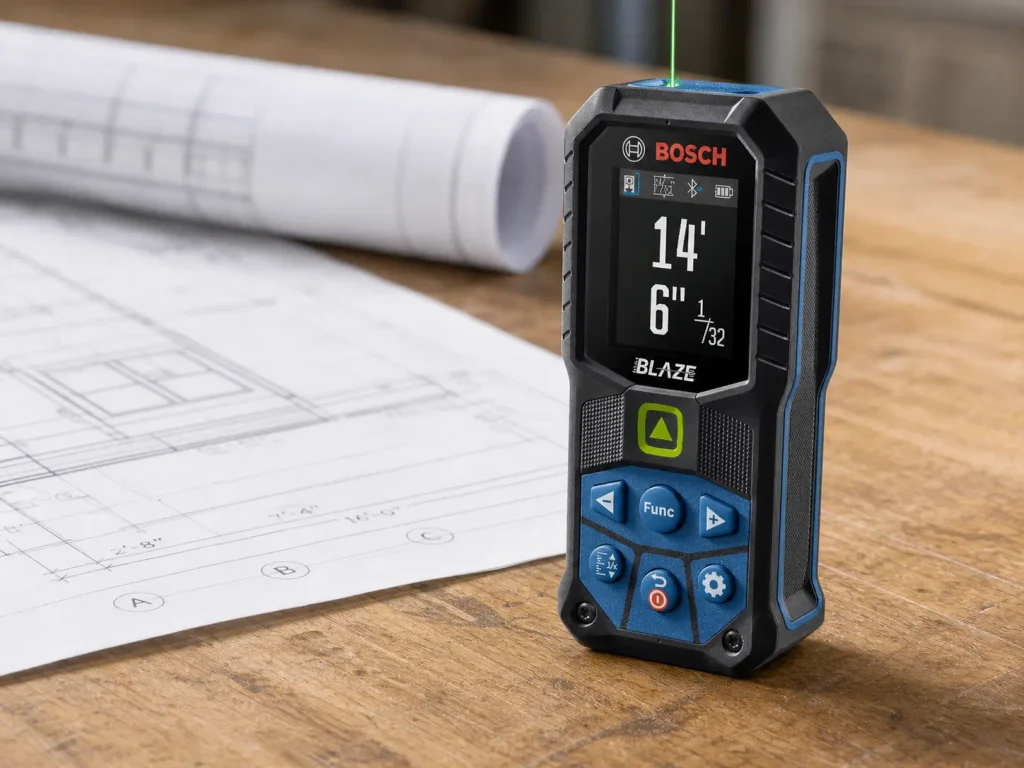
Spanning up to 165 feet with ±1/16-inch accuracy, this pocket unit calculates area, volume, and indirect ceiling heights instantly. It also adds a built-in inclinometer to measure roof pitches and level angles.
Its full-rubber overmold cage meets strict international IP65 dust and water standards, surviving jobsite drops onto concrete. Haptic vibration confirms every measurement in loud workshops.
Built-in Bluetooth lets you beam dimensions directly into the free Bosch MeasureOn smartphone app to mark up digital floor plans. If you skip the app, the backlit color screen offers an intuitive digital tape-measure view.
The trade-off is power consumption: driving both a bright green diode and a color display drains the two AA batteries faster than basic models. Still, its optical clarity makes it unbeatable for bright indoor renovations.
Check current price of Bosch BLAZE GLM165-27CG on Amazon
Bosch GMS120-27 — The Multi-Material Safety Scanner for Older and Complex Walls
Basic stud finders only detect density changes, leaving you guessing between a wood stud, a drainpipe, or an electrical line. The Bosch GMS120-27 eliminates blind drilling by combining three distinct detection modes in one rugged housing.
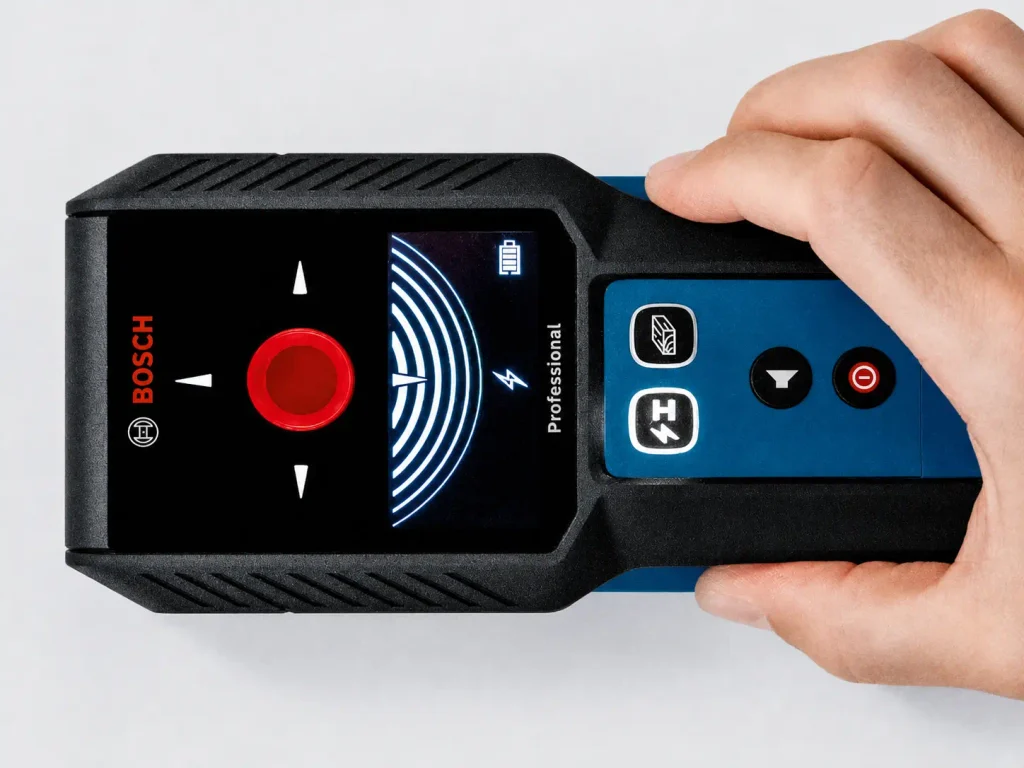
It locates wood substructures up to 1.5 inches deep, non-ferrous copper pipes up to 3.1 inches, and magnetic metal up to 4.7 inches. Most importantly, continuous AC sensing flags live 110V wiring up to 2 inches deep.
Instead of forcing you to decode tiny LCD bars, Bosch surrounds the physical center marking hole with an illuminated LED ring. That ring shifts from green to yellow to flashing red as you approach targets.
The physical through-hole lets you mark your exact drill spot with a pencil without shifting the tool. A rubberized bumper on the back protects fresh wall paint from scuffs during sweeping.
Because it relies on single-point inductive and capacitive sensing, you must sweep the scanner slowly rather than getting an instant multi-LED readout. It remains the safest choice for older homes with unpredictable plumbing.
Check current price of Bosch GMS120-27 Wall Scanner on Amazon
Franklin Sensors ProSensor M210 — The Instant-Read Array for Fast Drywall Framing
Traditional stud finders demand a frustrating calibration ritual before every scan, failing completely if you accidentally start over a stud. The Franklin Sensors ProSensor M210 eliminates calibration by packing 13 patented precision sensors across its seven-inch faceplate.

Press the button against the wall, and a horizontal row of bright green LEDs illuminates the full stud width immediately. You see both edges and the center simultaneously, easily spotting double studs or odd framing corners.
Built with a tough ABS shell, the M210 includes a dedicated live-wire warning meter in the top corner. It automatically adjusts sensitivity through drywall up to 1.7 inches deep without manual toggles.
Its wide footprint glides smoothly across textured orange-peel or knockdown walls without catching. A built-in pencil caddy on top keeps a marker handy while you work up on a ladder.
Keep two limitations in mind: the electronics strictly require standard alkaline AA batteries rather than lower-voltage rechargeables, and it cannot read through lath-and-plaster walls. For standard sheetrock homes, nothing matches its pure speed.
Check current price of Franklin Sensors ProSensor M210 on Amazon
Getting Clean Readings From Your Laser Measures and Wall Scanners
Even top-tier layout tools struggle when user technique gets sloppy on real jobsites. Static electricity often builds up on dry winter drywall, triggering false ghost readings on capacitive stud sensors.
Pressing your free palm flat against the wall a few inches away grounds that static charge instantly. Rather than scarring fresh paint with dark pencil marks, keep a roll of ScotchBlue Painter’s Tape in your pouch to flag stud edges cleanly.
That same roll of matte blue tape solves a common optical headache for laser distance tools. Sticking a strip of tape onto dark cabinets or glass doors prevents laser scatter and ensures consistent millimeter readings.
However, skip electronic wall detectors entirely if your house has metal mesh stucco, foil-backed insulation, or thick wet plaster over wood lath. Electronic fields cannot pierce metallic barriers, so use a rare-earth magnetic stud finder to locate drywall screws instead.
Clearing Up Common Questions About Optical Beams and Wall Sensors
Why is a green laser measure better than a red laser measure for indoor renovations?
A green laser measure is superior to a red laser measure for indoor renovations because the human eye is four times more sensitive to green wavelengths around 515 nanometers, making the dot visible in bright rooms.
Red lasers cost less and conserve battery power, but their dots vanish near sunlit windows. Stepping up to a green diode saves you from squinting across long hallways.
Can electronic wall scanners detect studs and pipes through lath and plaster walls?
Standard capacitive stud finders cannot reliably detect wood studs through lath and plaster due to uneven thickness, whereas multi-mode inductive wall scanners can locate metal nails and pipes embedded behind the plaster.
If you own a pre-1950s home, skip wide LED drywall arrays that get confused by dense plaster coats. Use a deep-metal detector like the Bosch GMS120-27 to trace vertical lines of lath nails instead.
Do laser distance measures and electronic stud finders require manual calibration before every use?
Factory-calibrated laser distance measures and multi-sensor array stud finders do not require manual calibration, while single-sensor capacitive detectors self-calibrate automatically when placed against empty drywall before scanning.
With laser units, simply keep the glass lens clean of drywall dust and verify the rear reference edge setting. For multi-sensor stud finders, just hold the button and read the LEDs immediately.
Which Precision Tool Belongs in Your Renovation Bag?
If you want one distance tool that retires your metal tape measure for good, grab the Bosch BLAZE GLM165-27CG. Its bright green beam, built-in angle sensor, and Bluetooth app syncing make measuring rooms effortless.
Investing in dependable laser measures and wall scanners takes the stress out of spring remodeling. Pair the Bosch laser with the Franklin Sensors ProSensor M210 for fast drywall framing, or choose the Bosch GMS120-27 to dodge hidden pipes and wires in older walls.
Check current price of Bosch BLAZE GLM165-27CG on Amazon
Want more recommendations? Head back to our homepage to see all our everyday picks.