As an Amazon Associate, I earn from qualifying purchases. This post may contain affiliate links, meaning I get a commission if you decide to make a purchase through my links, at no cost to you.

Carrying a dedicated emergency tire inflator for car travel is the smartest roadside insurance you can own once pothole season hits.
Every year around late February, the freeze-thaw cycle turns northern and midwestern asphalt into an obstacle course. Water seeps into hairline road fissures, freezes overnight, expands, and collapses under commuter traffic.
According to data from AAA’s automotive research, pothole-related damage costs American motorists billions of dollars each year, with single wheel and tire repairs averaging hundreds of dollars per incident.
A direct pothole impact does not always result in a dramatic roadside blowout.
More often, the impact bends an inner alloy wheel flange just enough to break the airtight bead seal.
Your tire begins losing 2 to 4 PSI every few hours, and your tire pressure warning light trips on your evening commute.
Pulling into a gas station to fix the problem often leads to frustration.
Commercial station pumps are frequently out of order, vandalized, or missing their brass chuck seals.
Even worse, their uncalibrated analog gauges can easily be off by several pounds.
Carrying a compact tire inflator in your trunk is one of the easiest ways to protect your wheels, maintain fuel economy, and avoid standing outside in freezing slush.
At a Glance: Top Roadside Recovery Picks
| Model | Best For & Power Type | Check Pricing & Availability |
|---|---|---|
| VIAIR 85P | Indestructible passenger car setup; 12V DC plug-in | View on Amazon |
| Fanttik X8 APEX | Modern EVs and sedans; cordless rechargeable battery | View on Amazon |
| DEWALT DCC020IB | Trucks, campers, and jobsite tires; 20V battery & 12V DC | View on Amazon |
| Slime 2040-A Kit | Essential puncture repair; solid-steel T-handle plugger | View on Amazon |
1. VIAIR 85P: The All-Metal Mechanical Workhorse
If your primary goal is absolute long-term durability, the 🛒 VIAIR 85P remains the gold standard among 12V vehicle inflators.
Unlike lightweight consumer units housed in thin plastic shells, the 85P uses an anodized aluminum cylinder head with external cooling fins.
The entire unit weighs over four pounds, giving it the solid, reassuring heft of professional shop equipment.
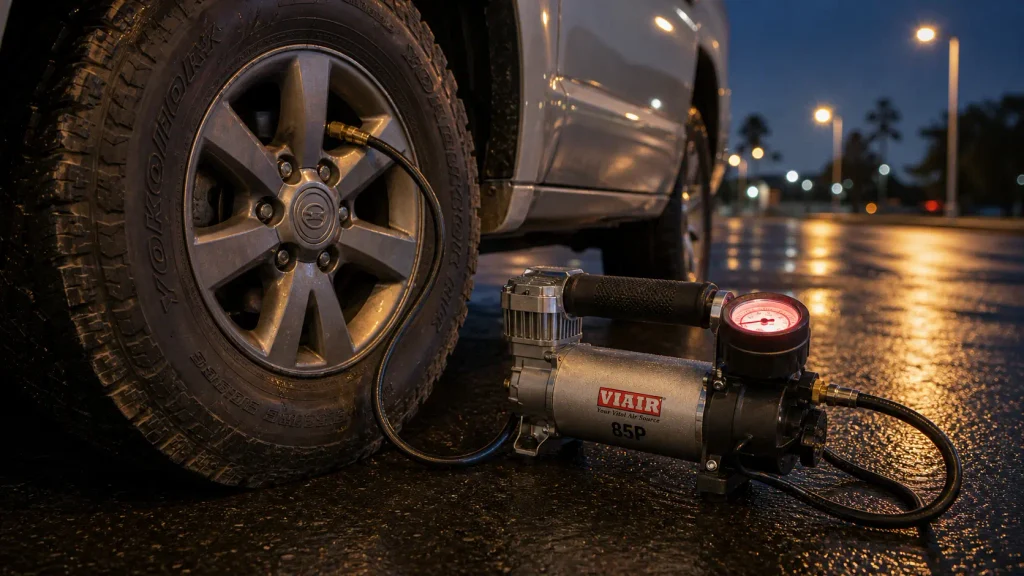
According to VIAIR’s engineering specifications, the 85P delivers 1.26 CFM of free airflow at 0 PSI and supports tires up to 31 inches in diameter.
It connects to your valve stem using a threaded, knurled brass chuck, completely bypassing the air leaks common on cheap clamp-on levers.
The trade-off with this design is its purely analog interface.
There is no digital preset or auto-shutoff mechanism, meaning you have to watch the dial and flip the power toggle yourself when your tire reaches spec.
Because the motor draws up to 14.5 amps at peak load, VIAIR specifies that your engine must be running while in use to safeguard your 12V lighter circuit.
If you want a dependable pump that can sit in a freezing spare-tire well for years without battery degradation, this corded system is hard to beat.
🛒 Check Current Price on Amazon: VIAIR 85P →
2. Fanttik X8 APEX: Cable-Free Everyday Convenience
If you want an emergency tire inflator for car storage that eliminates greasy power cords in the dark, the Fanttik X8 APEX is built around modern cordless convenience.
Shaped roughly like an insulated travel thermos, it eliminates the need to drag salty, dirty 12V power cords across your interior carpet.
Its matte-black housing features perimeter cooling ports and a braided heat-resistant hose that docks flush into the top handle.

The unit is powered by an internal 7800mAh rechargeable lithium battery and features a dual-line OLED display.
You screw the hose onto the tire valve, select your vehicle’s recommended cold pressure down to 0.5 PSI, and press start.
The twin-cylinder motor runs until the target pressure is reached and shuts off automatically.
Its manufacturer rating of 32 liters per minute allows it to top off standard commuter tires in just a couple of minutes, while an integrated USB-C port lets it double as a portable power bank.
Keep in mind that lithium-ion battery chemistry naturally slows down in prolonged sub-zero weather.
Leaving the device in an unheated vehicle through extreme cold will cause gradual standby capacity loss.
To keep it road-ready, store it in your heated cabin or top off the internal battery indoors via USB-C once every ninety days.
🛒 Check Current Price on Amazon: Fanttik X8 APEX →
3. DEWALT 20V MAX (DCC020IB): High-Volume Power for Bigger Rigs
Drivers who pilot half-ton pickups, pull landscape trailers, or run heavy load-range E tires need substantial airflow volume.
Smaller handheld compressors frequently overheat or trigger internal thermal shutoffs on high-volume tires.
The 🛒 DEWALT DCC020IB is engineered specifically to handle those heavier workloads.

The tool features a wrap-around roll cage, thick vibration-absorbing rubber feet, and a digital auto-shutoff gauge rated up to 160 PSI.
Its standout design feature is hybrid power input:
- It runs cordlessly on any standard DeWalt 20V MAX power tool battery.
- It plugs directly into your truck’s 12V dash port via an included 13-foot power lead.
- It can connect to standard 110V AC garage wall power using an optional adapter.
It also includes a dedicated high-volume mode with a secondary onboard accordion hose.
This lets you fill air mattresses, camping gear, or lake inflatables in seconds without wearing down the high-pressure piston.
However, the tool’s footprint is roughly the size of a jobsite lunchbox, and it weighs over five pounds bare.
It takes up real cargo space and is primarily sold as a bare tool, meaning you will need existing DeWalt batteries or an optional power kit to use it cordlessly.
🛒 Check Current Price on Amazon: DEWALT DCC020IB →
The Roadside Companion: Slime 2040-A Heavy-Duty Tire Plug Kit
An air compressor is only half of a roadside solution.
If road debris or a sharp asphalt edge leaves an open puncture in your tread block, an inflator will simply pump air straight through the leak.
Pairing your pump with a dedicated mechanical plug kit like the 🛒 Slime 2040-A Deluxe Kit gives you a true temporary repair solution.
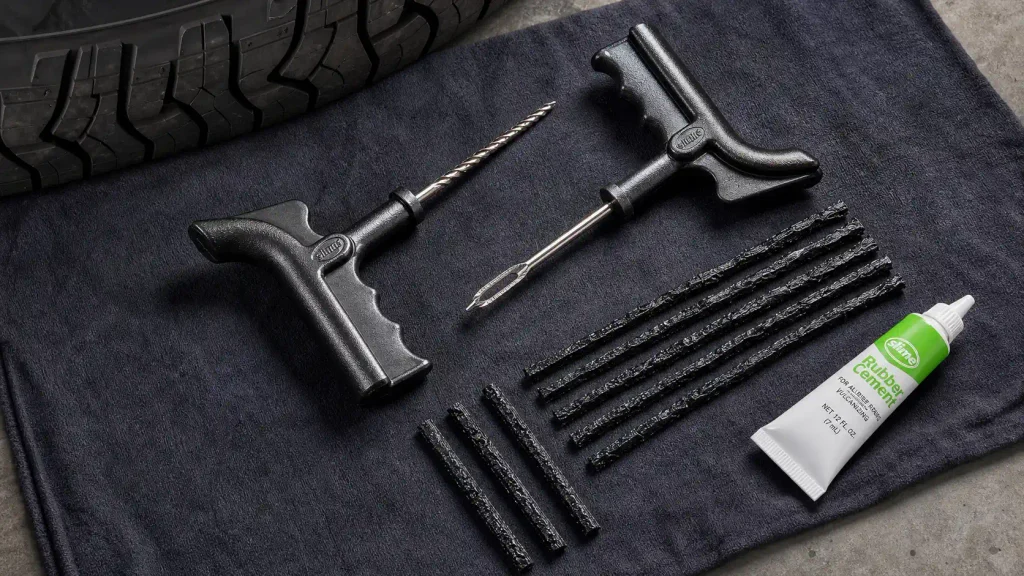
Inexpensive roadside kits often rely on cheap plastic handles that can snap under the force needed to pierce steel radial belts.
The 2040-A kit uses solid cast-alloy T-handles that let you apply firm upper-body leverage safely.
It includes a spiral reamer, a split-eye needle tool, rubber cement, and thick vulcanized butyl cords.
For a standard tread puncture:
- Locate the puncture site and pull out the nail or screw with pliers.
- Run the spiral reamer through the opening to clean the steel belt channel.
- Thread a vulcanized cord through the needle eyelet and coat it with rubber cement.
- Push the tool straight through the tread, pull back sharply to seat the plug, and slice off the excess rubber flush.
- Hook up your inflator to restore factory cold tire pressure.
This five-minute workflow seals the leak well enough to get you to a licensed tire technician without waiting hours for a flatbed tow truck.
🛒 Check Current Price on Amazon: Slime 2040-A Kit →
Practical FAQ: Roadside Air & Cold Weather Physics
Can hitting a pothole cause a slow leak without a visible tread puncture?
Yes, pothole impacts frequently bend the inner rim lip or unseat the tire bead, allowing air to escape along the wheel edge at a rate of 1 to 3 PSI per day.
According to tire maintenance recommendations from the National Highway Traffic Safety Administration (NHTSA), maintaining proper inflation is critical for vehicle control and blowout prevention.
If your dashboard warning alerts you every couple of mornings, top off the tire to the specification listed on your driver-side door jamb and recheck it 24 hours later to catch slow bead leaks early.
Why are gas station air pumps almost always inaccurate?
Gas station gauges are exposed to daily drops, road salt, moisture, and extreme temperature fluctuations, routinely throwing mechanical readings off by 4 to 8 PSI.
Furthermore, driving several miles to reach a gas station heats up the air inside your tire casing, creating an artificially high pressure reading.
To match the cold tire pressure specification recommended by vehicle manufacturers, tires should always be checked and filled cold before driving.
Does cold weather affect a cordless emergency tire inflator for car battery kits?
Freezing weather does not permanently ruin quality lithium-ion cells, but low temperatures temporarily increase internal electrical resistance, cutting operational runtime by roughly 20% to 30%.
If you keep a cordless unit like the Fanttik X8 APEX in your car during winter, recharge it indoors every three months.
If you prefer a completely hands-off emergency tool that ignores freezing conditions, a corded 12V DC system like the VIAIR 85P is the more practical option.
The Road Ahead: Picking an Emergency Tire Inflator for Car Travel
When you look at the math, a reliable tire inflator costs somewhere between $35 and $120.
A single flatbed tow call on a Friday night easily runs $150 before tip—not to mention the hour or two spent sitting in the cold waiting for help to arrive.
Having compressed air in your trunk isn’t about being an extreme off-roader or a certified mechanic.
It’s simply about keeping a minor pressure drop from turning into a ruined wheel and a wasted afternoon.
Pick the power setup that matches how you actually drive, keep a plug kit right beside it, and you can roll through pothole season with total peace of mind:
- For pure plug-in, all-metal longevity: 🛒 Get the VIAIR 85P on Amazon
- For clean, cord-free glove box convenience: 🛒 Get the Fanttik X8 APEX on Amazon
- For high-volume truck and trailer muscle: 🛒 Get the DEWALT DCC020IB on Amazon
- For immediate on-tread puncture sealing: 🛒 Get the Slime 2040-A Repair Kit on Amazon
Want more recommendations? Head back to our homepage to see all our 2026 everyday picks.